
Which Fold? Roman Shades for Quad Cities Dining Rooms
In a lot of houses the dining room does most of its work between Thanksgiving and March. Most of those meals happen after dark. That changes how I'd pick the shade. For Roman shades in a Quad Cities dining room, the fold and the lining matter more than the color. A flat fold with a lining suits most rooms. A relaxed fold can soften a room full of hard edges.
Start with the folds. They're the part you notice from your chair. The lining and the fabric decide how the room looks once the lamps are on.
What is a Roman shade, and why a dining room?
If you haven't lived with one, a Roman shade is one piece of fabric that gathers into folds on the way up. Lowered, it hangs smooth and flat over the glass and looks finished without the bulk of full drapes.
It suits a dining room, where you sit close to the window and at eye level with it for an hour. A shade that looks like fabric belongs there more than a set of slats does. Skip it on a patio door or a window you open every day, since a blind or cellular shade is easier there.
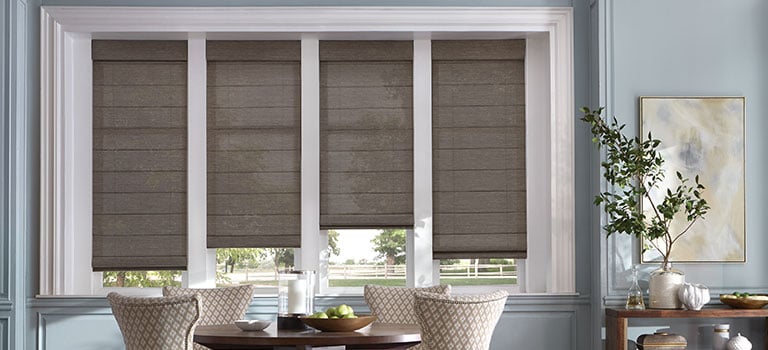
Crisp folds or soft folds?
Crisp or soft is the first real choice, and it sets the mood of the whole room. We offer five fold styles. For a dining room it comes down to three: flat, relaxed and hobbled (our Soft Fold).
| Fold | What it looks like | Where it fits |
|---|---|---|
| Flat | Smooth panel, neat stacked folds | Most dining rooms; busy wallpaper or patterned fabric |
| Relaxed | A gentle curve at the bottom | A room with lots of hard edges, like square trim and a big table |
| Hobbled | Soft loops stacked down the whole shade | A formal room with plain fabric and room for some drama |
Most people stall on flat vs relaxed. If your fabric has a pattern, go flat. A pattern needs a smooth surface to read well, and a curve bends it. Stripes show it the most. If the fabric is a solid and the room feels stiff, a relaxed fold softens it.
The hobbled fold looks fuller, even when it's down. I like it on one tall window, not on a row. Across three windows it gets busy fast, and the room can start to feel smaller than it is.
Lined, and lined with what?
Line nearly every dining room Roman shade. Unlined fabric looks thin this close to the table. A lining gives the folds more body, so they stack evenly instead of sagging.
Then pick the kind. A light-filtering lining keeps the room bright by day. If your dining room faces the street, a room-darkening lining is the better choice for the evenings. A room that looks onto a private backyard can keep the lighter lining.
People tend to forget about cold glass until the first hard freeze. A lined Roman shade adds a layer at the window, but it isn't built for warmth. If the window by the table runs cold every winter, a cellular shade may be the better pick for that one window. The cellular shades post for Moline and Rock Island goes into how they handle cold glass.
How will the fabric look by lamplight?
On Thanksgiving Day in Blue Grass, the sun goes down around 4:35 (U.S. Naval Observatory). So the big meal often happens after dark, and the same goes for most winter dinners. The way a fabric looks under your own lights matters more in this room than anywhere else in the house.
Warm bulbs pull fabric toward yellow, so a cool gray can turn muddy and a bright white can look cream. Lamplight also brings out texture. Linen and other nubby weaves look richer at night, while a flat and shiny fabric can look plain.
So judge every sample twice. Look at it in daylight with the shade at the window. Then look again after dark with the dining room light on and the shade down. We bring the samples with us, so you can test them beside your own table and walls. Pick the one that looks better at night if two fabrics tie, because evenings are when this room gets used.
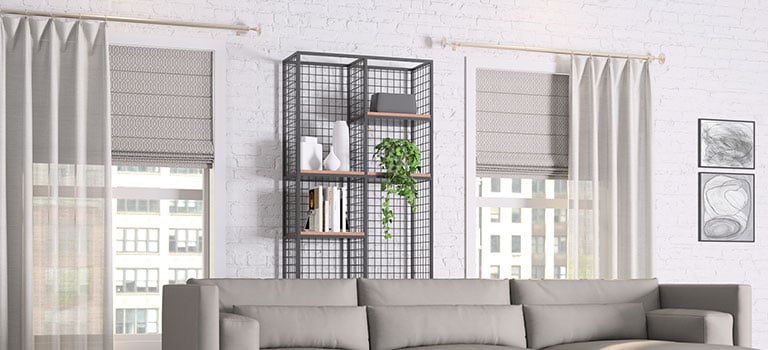
How will it mount and lift?
Inside the frame or outside it? Look at your trim first. An inside mount shows off the trim and looks built in if the frame is deep enough to hold the shade flush. An outside mount goes on the wall above the window. It can make a short window look taller, and it covers more of the glass at the edges. If your trim is plain or the frame is shallow, mount outside and go a bit higher than the glass. The Quad Cities guide to measuring for blinds shows how to check the depth.
Our Roman shades come cordless, or you can go motorized. Cordless is plenty for most dining rooms, since you'll likely set the shade once in the morning and once at dusk. A motor makes sense if a buffet or a hutch sits in front of the window. If a neighbor's window looks at your table, ask about the top-down/bottom-up option. On a plain fabric, a contrasting band along the edges looks sharp.
The fold I'd pick for a Quad Cities dining room
You'll find the folds, fabrics and linings on our Roman shades page.
My own pick is the plain one. That's a flat fold in a solid or a soft pattern. Line it room-darkening if the table faces the street. Hang it just above the frame so the folds stack clear of the glass. The softer folds are lovely in the right room. The flat fold is the one that still looks right on a February night with every lamp on. When you want to see it in your own room, we'll bring Roman shades in the Quad Cities to your table.
Kevin Sill is CFO and co-owner of the family-owned Budget Blinds franchises serving the Quad Cities.