
Close Neighbors? Quad Cities Top-Down Bottom-Up Shades Help
Does your side window look straight into the neighbor's? Try lowering the shade from the top instead of raising it from the bottom the way you always have. That's what top-down bottom-up shades do. On the tight lots we see more and more of around the Quad Cities, they're the first thing I'd show you. The fabric covers the lower glass, right where their window lines up with yours. The top stays open, so you keep the sky and the daylight.
Bettendorf has been adding about 100 new single-family homes a year. On a lot of the newer streets, the houses sit close enough that your side window and theirs line up.
Start with where their window sits
Close-neighbor privacy feels like one problem when you're standing at the sink. It's really three or four, and each has its own fix. What matters most is where the neighbor's window sits compared to yours, and mostly that means how high it is.
Say their window is straight across from yours on the same floor. Their line of sight hits the lower half of your glass, where you sit and stand. Top-down bottom-up was made for that. Drop the top to just above eye level and you're set.
If their window is higher, say their house sits up a little or their second floor looks down into your first floor. Now the view comes in through the top of your glass, and dropping the top would open exactly the part they look through. You want the opposite: the upper glass covered and the bottom open. A regular shade lowered partway does that. So does a top-down bottom-up shade with its top rail left up and its bottom rail raised.
If their patio or yard sits below your window, they see mostly ceiling unless you're standing at the glass. A light-filtering shade dropped from the top a few inches is often plenty.
Then there's the house behind you, across a shared back yard. It's farther away than the house next door, but there's nothing at all in between to block the view. Those are usually bright family rooms and kitchens where you want the light. Top-down bottom-up works well there, set a little lower than on a side window.
To figure out which case you have, go stand in your side yard. Look back at your window from about where their window is. You'll see right away which part of your glass is the problem. It takes a minute, so do it before you shop. You'll save yourself a guess.
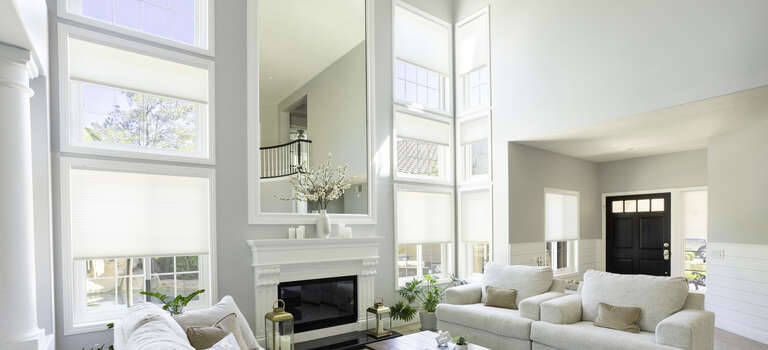
Setting a top-down bottom-up shade on a close lot
The shade has a top rail and a bottom rail, and both move. Ours come cordless, so you slide each rail by hand. Most people end up with one or two favorite settings for each window and leave them there most of the day.
On a side window, the setting that matters is the top edge of the fabric. Set it for how you actually use the room, and for where you usually sit or stand in it. You're usually sitting in a kitchen or eating area, so the fabric can stop lower. In a hallway or a room where you stand, it has to come up higher. The bigger the gap between houses, the lower that edge can go.
For a window you can't reach, like the tall one on a stair landing, ask about a motorized shade. Whether a motor pairs with top-down bottom-up depends on the product, so that's something we'd sort out at the window. Our guide to split-level and bi-level windows covers landing windows in the older layouts too.
Top-down bottom-up comes on four kinds of shades. Roller and solar shades don't. If you've got your heart set on one of those, this feature isn't on the table.
| Shade | What it's like | Where I'd use it |
|---|---|---|
| Cellular | Honeycomb cells that trap air and help insulate | Most side windows. It's my usual pick. |
| Pleated | Crisp pleats, a lighter look | Where warmth matters less |
| Roman | Soft fabric folds | Living and dining rooms |
| Woven wood | Natural texture | Living areas, with a liner for night |
Cellular shades are what most close-lot homes end up with. They come in four light levels, sheer up through room darkening. Raised, they fold into a slim stack that leaves most of the glass clear. The fabric choices are on our cellular shades page.
Pleated shades look similar. They insulate less. Roman shades bring a dressier look. Woven wood is beautiful, but without a liner it's close to see-through. Plan on a privacy or blackout liner for any room you use at night.
Do light filtering shades give you privacy at night?
Not completely. By day it hides the room well. Once your lamps are on, though, the folks next door can make out someone moving around behind it. In the kitchen or living room that's usually fine. For bedrooms and bathrooms, I'd go with room darkening. And close the shade all the way at night in any room that faces the house next door. Leaving the top open after dark only helps the neighbors.
Think about fall, too. If a tree between you and the neighbor does some of the work in summer, it won't in November. Our season-by-season guide covers what changes when the leaves come down.
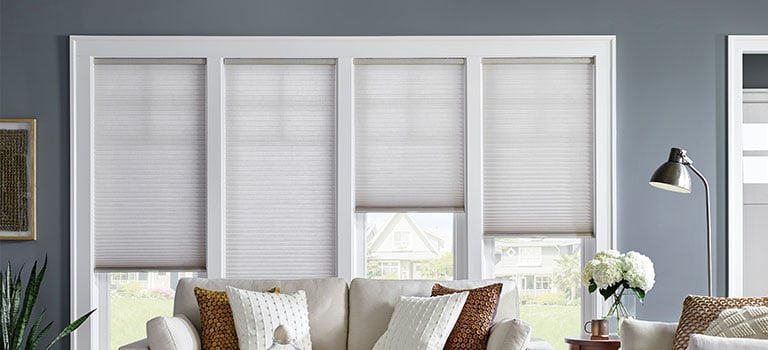
Other ways to handle a close neighbor
Top-down bottom-up isn't the only tool. Sheer shades have soft fabric vanes between two sheer layers. By day you get privacy and a view out, and at night you close the vanes so nobody sees in. They're a nice pick for a living room where you want a softer look, though they don't open from the top.
Café shutters only cover the lower half of the glass. It's the same idea as a top-down shade done in wood or composite. They look great in a kitchen. For the neighbor who looks down on you, a plain shade lowered partway beats all of these.
A patio door that faces the neighbor is its own case. It needs something that moves sideways, like a vertical cellular shade or a panel track. A shade that goes up and down fights with a door you use all day.
The in-home consultation is free. We'll stand at your problem window with you and set the top edge where it feels right. Then we'll measure every window that faces a neighbor and go over the numbers with you at the table. You'll find the rest of what we do with top-down bottom-up shades in the Quad Cities on our home page.
If it were my house, I'd start with the window I keep shut all day because of the house next door. I'd put a light-filtering cellular shade there with the top dropped to just above eye level and live with it for a week. If that feels right, the rest of that side of the house is easy. Use the same fabric at the same height, with room darkening in the bedrooms.
Kevin Sill is CFO and co-owner of the family-owned Budget Blinds franchises serving the Quad Cities.