
Eden Prairie Great Rooms: Motorized Shades Near Burnsville
If you've got a two-story great room with windows you can't reach, I'd put motors on those shades. You press a button on a remote or a wall switch, and both rows move. Nobody climbs a ladder. Picking motorized shades for great rooms around Burnsville, Eden Prairie and Savage comes down to three things. Which windows to cover, what each row should do and who in the house will run them.
How a motorized shade works, and who runs it
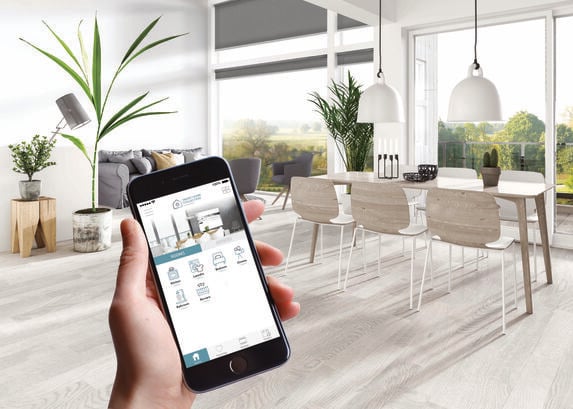
Each shade has its own small motor tucked inside the roller or the headrail. When it gets a signal, it raises or lowers the fabric. You can move one shade or a whole group, so one button can bring down every shade on the top row together. The app can save settings like "movie night" or "morning." It can also run schedules that follow sunrise and sunset where you live. If you want the shades to react on their own, you can add sun or temperature sensors.
Then picture the people who actually live in the room. The teenager will happily use the app. The grandparent who visits on Sundays won't, and wants a plain switch on the wall by the stairs. Whoever owns the couch will want a remote, at least until it slides between the cushions. A motorized wand on the edge of the shade is a nice middle ground, because there's nothing to lose. And if you already talk to a smart speaker at home, voice control is there too.
In most great rooms I'd set up a switch for everyday use and let the app handle the schedule in the background. If you already have a smart home system, check that the shades will work with it before you choose. Our motorized shades page shows all the controls.
Which rows need covering
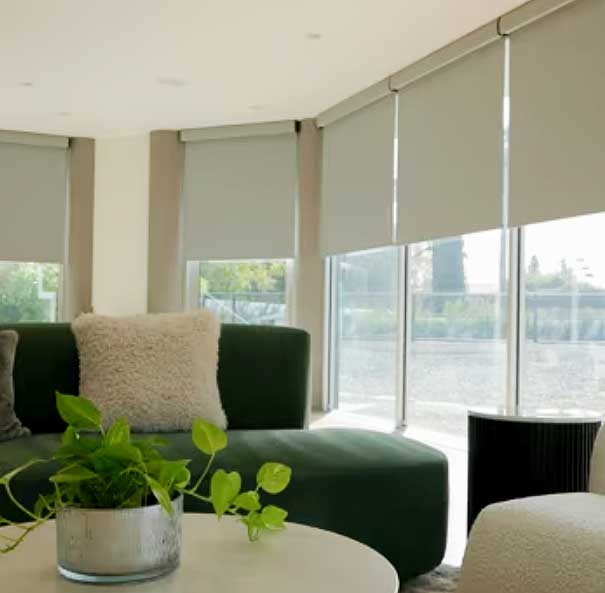
Not every pane needs a shade. Before you pick anything, notice where the glare lands on the TV, the island and the couch. Notice when you feel watched after dark with the lamps on, too. In spring and fall the sun sits low in the east at breakfast and low in the west by dinner. That low sun comes straight through both rows of tall glass and deep into the room. Our post on which way your Burnsville rooms face goes through all four directions if you're not sure about yours.
In most great rooms, the lower row causes the everyday trouble. It's at eye level, where the late sun hits your eyes and the TV. It's also the row people see into from the yard. So it gets covered first. You can reach most of it. I'd still think about a motor if a sofa or a deep window seat is in the way, since you'd be leaning over furniture twice a day. The lower row is also a good spot for a top-down/bottom-up shade. It lowers from the top, so you get sky and daylight up high while the bottom stays closed. That option comes on cellular, pleated, Roman and woven wood shades. There's a motorized version too.
The upper row depends on the room. Some never need anything. In some rooms it's pure sky and treetops, and it never bothers anyone. In others it throws a bright stripe across the floor in the afternoon, while the sun is still fairly high. At night a tall wall of bare glass turns into a big black mirror from inside. Anyone outside can see straight in. Eden Prairie has nearly 10,000 acres of parks and open space. Plenty of great rooms here look out at woods or a preserve. That's the case for a motor up top. It can stay open for the view all day and close every night without anyone thinking about it.
Some families do the lower row first and add the upper row later. Others want the whole wall done at once so the room can go dark for a movie. Either way works. If you'll add the upper row later, pick the fabric and color now so everything matches.
One fabric for the whole wall
On a tall wall, matching matters more than in any other room. Two different fabrics stacked on top of each other look busy fast. I'd use one fabric, one color and one mount across every window on that wall. On very wide windows, two or three shades side by side often look cleaner than one huge one. They also let you lower just the section that's catching the glare.
The fabric choice comes down to day versus night. Solar fabric keeps the view during the day and cuts glare, but with the lamps on at night people can see in. Light-filtering fabric softens the light and hides more, though the room still isn't private after dark. Room-darkening fabric gives you real privacy at night, and it's the pick for a great room that doubles as a theater. Love the daytime view but want privacy at night? Keep solar on the wall and add drapes you pull across the lower row in the evening. Most solar fabrics are made in wide widths, which helps a wall of glass look even.
Schedules that follow the sun
In a two-story room, the schedule is what saves you the most reaching. You set it once and the shades do the rest. Say your great room faces west. A simple plan might look like this:
- Raise everything in the morning to let the daylight in.
- Lower the upper row in the early afternoon, when the higher sun starts striping the floor.
- Bring the lower row down in the late afternoon, when the low sun reaches the TV and the couch.
- Close the whole wall at bedtime, or when the lamps come on if the room faces the street.
You can tie those steps to the actual sunset, so they shift on their own as the days get longer. Sunset is around 8 in April and past 9 by late June. An east-facing great room runs the other way. The morning sun is the problem, so both rows come down early and go back up by late morning. Schedules help when you travel, too. Shades that open and close on their own make the house look lived in.
Power, upkeep and the shades you already have
Every motor needs power. Sort that out early. Some motors run on batteries. They need a new battery now and then, and on an upper row that means someone has to reach it. Other motors are wired in and need a power source near the window. Which one fits depends on your walls and whether there's power close by. If you're building, ask your builder before the drywall goes up. Our Lakeville and Rosemount new-build timeline shows when that decision comes up.
There are a few other trade-offs worth knowing before you decide which windows get motors and which ones you'll simply reach up and move by hand. Any motor hums a bit while it runs. In a great room it rarely matters, but in a bedroom I'd ask for a quiet motor. Remotes tend to wander off. That's one more reason I like a wall switch or a wand in a busy room. And there's a little learning. Our own team pairs the remotes when we install and shows you the app. Even so, someone in the house usually ends up being the shade person. A small window you can reach doesn't gain much from a motor. I'd save motors for glass you can't reach and big groups you want to move together.
Already have shades up there that still look good? A retrofit kit can motorize some existing shades and blinds, depending on the type and the model. It makes the most sense in a great room that was finished years ago. The fabric is fine, and the only problem is the ladder. If yours can't be retrofitted, we'll say so and show you what would work. Our motorization page has more on retrofits and smart home setups.
Tall windows look different at 8 in the morning than they do at 6 at night. If you can, have us come by at the hour that's worst. It helps to know which way the room faces and where the outlets are near the windows. Tell us what smart home system you use, if you have one. We'll bring fabrics for both rows and measure every window while we're there. You can book that free in-home visit through our motorized shades in Burnsville page.
Kevin Sill is CFO and co-owner of the family-owned Budget Blinds franchises serving the Southern Twin Cities.