
Plantation Shutters Near Burnsville for Eagan Two-Stories
Shutters stay on a window for a long time, so where you put them matters more than the color. If you're looking at plantation shutters in Burnsville or Eagan, start with the main-floor rooms you use all day and any window that looks straight at a neighbor. They're a weaker fit on a wide patio door, or in a bedroom that has to be truly dark.
Most two-story homes end up with shutters in some rooms and a shade or drape in others.
Why shutters suit an Eagan two-story
A lot of Eagan was built during the city's fast growth in the 1980s. If you live in a two-story from those years, the layout is probably familiar. There's a living room and dining room at the front, then a family room and kitchen across the back. The bedrooms are upstairs, and there's often a tall window over the stairs.
If your rooms have plain trim and windows that match, a shutter set inside the frame looks like it came with the house. For a lot of people that built-in look is the main reason to buy them.
The land around the house matters as well. Eagan has rolling hills and a lot of lakes, wetlands and ponds. If your back windows look across water or a wooded slope, let that view shape the louver size you pick. Wider louvers mean fewer slats in your line of sight when they're open.
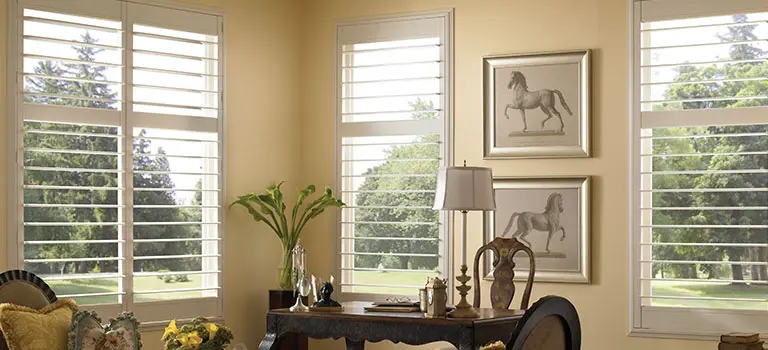
How should the louvers sit when the sun is this low?
By mid-November the sun hangs low in the southern sky over Eagan, even at noon. Low sun slides right under the roof overhang. It comes in flat and reaches deep into the room, sometimes all the way to the back wall.
Louvers handle that light well. In a back room where nobody can see in, tip the louvers until the beam lands on the ceiling instead of in your eyes. You keep the daylight, and the TV stays readable. When snow covers a frozen pond out back, light comes up from below as well. On those bright days, close the louvers partway and let the room glow.
After dark, close them all the way. Closed louvers cover the glass well, so the street doesn't get a view of your evening. You'll still see thin lines of light where the louvers meet. Our post on light and privacy on wooded Eagan lots in winter covers what changes once the leaves are down.
Which rooms in a two-story should get shutters?
Front living room and dining room. These face the street and get the most looks from the sidewalk. Shutters give a tidy look from outside and easy privacy inside. By day, tilted louvers keep the room private and still let sky light in. This is the room to do first.
The window over the stairs. It's often tall and hard to reach. A shutter there can have a hidden tilt rod, or a motor if you'd rather not lean over a railing. If the window has an arched top, shutters can be built to that shape too.
Kitchen and back family room. Composite is the pick near the sink. It's a polymer that won't warp, peel or crack in a damp room. In the family room, the patio door is the hard part. Shutter panels can slide on a bypass track or fold on a bi-fold track. Either way, they need wall space beside the door. If that door is how everyone gets to the deck, a shade or a panel track may be easier to live with every day.
Bedrooms upstairs. Shutters block most of the light. Still, a shuttered bedroom never gets pitch dark because light leaks in where the louvers meet and around each panel. For a kid who naps or anyone who sleeps past sunrise, I'd hang room-darkening drapes over the shutters. Another option is a blackout shade in that one room, with shutters everywhere else. The guide to which way your Burnsville rooms face in winter helps you decide which bedroom needs that extra layer.
Picking the color and louver for an Eagan two-story
Color is where most people spend their time, and white shutters on white trim are the classic match. If your trim is stained oak, a stained shutter can tie in with it. Along one wall of windows, keep the same color and louver size so the wall looks like one job.
I like a wider louver on those back windows that look out at a pond or the woods. A hidden tilt rod keeps the front of each panel plain.
Shutters come in real hardwood and polymer faux wood. Vinyl, composite and hybrid are options too. Real wood belongs in the dry living spaces. Save composite for the kitchen, baths and laundry. Each shutter is built to fit its own opening, and louver sizes and materials are on our plantation shutters page.
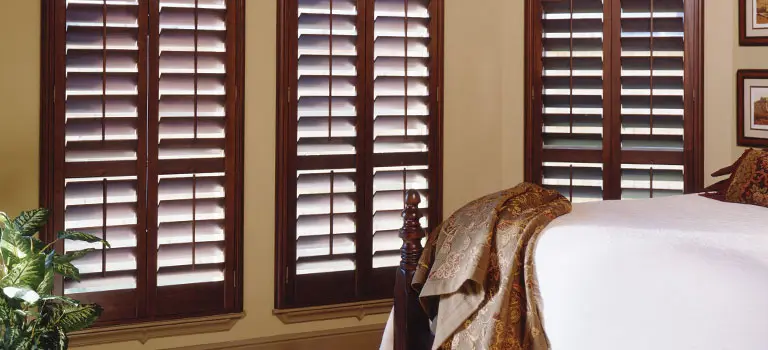
What are the downsides of plantation shutters?
First, the frame stays on the window even when the panels are open. So it always takes a little glass. A shade can lift nearly out of sight, but a shutter can't. On a small upstairs window that lost glass adds up.
The panels also swing into the room. Before you order, look for any lamp or furniture that sits close to the glass. Dust is the everyday one. Each louver is a small shelf, so give them a soft cloth or a duster now and then. Composite can take a damp cloth.
Shutters also stay put for years. Most people don't swap them after a few years, so I'd match the color to your trim and floors.
Where to start in an Eagan two-story
If it were my house, I'd put shutters on the front living and dining rooms and stop there for a while. Those are the windows the street sees and the ones you look at most. The back rooms and bedrooms can wait until you know how you really use them. When you want to talk it through, we'll come out and look at plantation shutters in Burnsville in your own front rooms.
Kevin Sill is CFO and co-owner of the family-owned Budget Blinds franchises serving the Southern Twin Cities.