
Room by Room: Top Down Bottom Up Shades in Burnsville MN
On a newer Elko New Market street, the house next door can sit close enough that you see their kitchen light from your couch. For that window I like a shade that opens from the top. You lower the top rail, and daylight comes in above the neighbor's line of sight. The lower glass stays covered. Top down bottom up shades in Burnsville and the towns south of it all work this way. Where you park the top rail is different in every room.
Which top down bottom up shades fit a newer house?
The shade has two rails. The top one comes down from the head of the window. The bottom one goes up like any other shade. The fabric fills the space between the two. That means you can open the top of the window or the bottom. You can also open a little of both.
Not every style comes this way. We offer it on cellular and pleated shades, and on Roman and woven shades as well. Roller shades and blinds don't do it. For close neighbors I usually start with a cellular shade. The honeycomb cells trap air against the window, and that helps on a cold winter night. It also stacks small when it's open, so you don't lose much view. It's cordless, and you can add a motor. The light levels are on our cellular shades page.
The city's 2040 housing plan says most of its homes went up in the 2000s, so builder blinds there are getting old. If yours are, replace the street side first and the windows that face the house next door after that. If your house is still bare or brand new, the timeline for window coverings in a new build shows when to order.
The same plan places the older homes near the old downtowns of Elko and New Market. If yours is one of those, we'll check the frame depth before choosing an inside or outside mount.
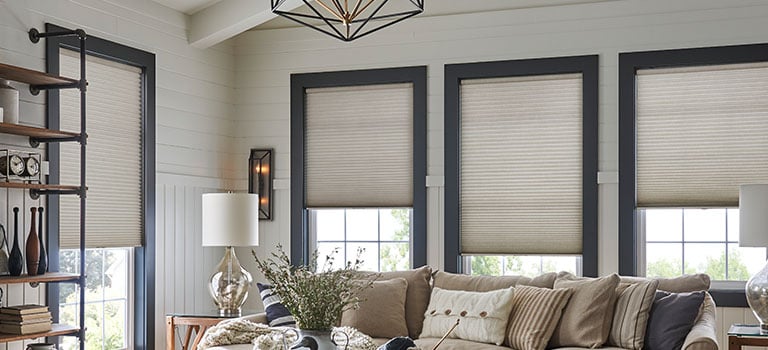
The front room, once the lamps come on
Once the days get short, houses start to glow early.
During the day, a top rail about a third of the way down is a good place to start. From the sofa you'll see sky and the tops of the trees across the street. The bottom of the shade covers the sofa and the floor, so anyone walking by sees the shade. Roman shades come with the same top-down option, and the Rosemount Roman shades post shows how that looks on a new street.
Close the shade all the way in the evening, since light-filtering fabric shows movement once the lamps are on. If you sit in that room every night, a room-darkening cellular fabric gives you more cover. Walkers pass more front rooms than you'd think. The city lists 9.5 miles of trails and 7.5 miles of sidewalks, so a lit front window on one of those routes gets seen.
One window can break the pattern. If you keep something in the front window for the street to enjoy, leave that one shade open. Close the other windows in the room instead. You can't show off a window and hide the room through the same glass.
Bedrooms: a strip of sky by day, closed tight at night
Side windows in a bedroom often look straight at the neighbor's side windows. Open only a narrow strip at the top. Then check it from the bed. If you can see any part of their window through that gap, raise the top rail until you can't. Morning light still reaches the room, and the part of the window at bed height stays covered.
For sleep, pick a room-darkening fabric. A top-down shade has small gaps at the sides and where the rails meet the frame. In most bedrooms that's fine. If someone in the house sleeps late on weekends, hang a lined drape over the shade.
Kids' rooms work the same way. With no cords to tangle, a child can push the bottom rail up or pull the top rail down by hand. Put the shade within easy reach if a teenager is going to run it. For younger kids, see our Lakeville post on cordless blinds in kids' rooms.
The bathroom window
A bathroom is where people most want a top-down shade, and where I'm most careful with fabric. In a powder room or a main bath with a good fan, a top-down cellular shade is a good pick. You keep the top open for light and leave the bottom closed all day.
Over a tub or shower that fills with steam, a fabric shade has a hard life. A faux wood blind is the safer pick there, since steam doesn't bother it and it wipes clean. It doesn't lower from the top, so you work the slats instead. In daylight, angle them so the neighbor's yard drops out of view from the spot by the shower. After dark with the light on, close them all the way.
The home office that looks at the next driveway
If your office sits in a front corner or by the garage, that window may face the neighbor's driveway. People pull in and walk past it every evening.
Park the top rail just above your eye level when you're sitting at the desk. Check that the gap shows only sky from your chair. The sky lights the room. The bottom of the shade blocks anyone looking in from the driveway. If late-day sun lands on your screen, push the top rail back up a few inches to cover more glass.
Light-filtering fabric is usually right for an office. It lets in plenty of daylight and softens it. If you work late and the desk faces the window, close the shade fully once it's dark.
Finding the line on your own windows
Find the line yourself on a bright afternoon. Take the seat you use most in the room. Pull the top rail down a little at a time while you watch the gap above the fabric. Sky, treetops and rooflines in the gap are fine. When the street or the next house's window first appears there, push the rail back up an inch. Stick a small piece of painter's tape on the frame at that height so anyone in the house can find it again.
Once you've found that line in one room, we can bring top down bottom up shades in Burnsville fabrics to the rest of your windows.
Kevin Sill is CFO and co-owner of the family-owned Budget Blinds franchises serving the Southern Twin Cities.