
Bay Window Coverings for Niagara Homes
A bay window almost always gets a separate covering on each window, not one piece stretched across the whole bay. In Niagara homes the usual choices are california shutters built to each opening, or a shade or blind on each window, with drapery hung either side of the bay if you want it softer. Which one suits your bay comes down mostly to the depth of the window casings and whether the side windows need to open.
Why a bay is harder than a flat window
Bays are flat windows set at angles to each other, and a bow does the same thing on a gentle curve, so on both the trouble is at the corners. Coverings mounted on the wall outside each frame can run into each other where two walls meet, especially when they are lowered or tilted. That is one reason inside mounts are common on bays, as long as the casings are deep enough to take a headrail or a shutter frame.
Side windows are the other catch. They are often narrow, and on a lot of bays they are the ones that crank open, so the covering has to clear the handle. Our guide on how to measure windows for blinds and shades has a section on bays and bows if you want to take rough numbers yourself first.
California shutters on a bay
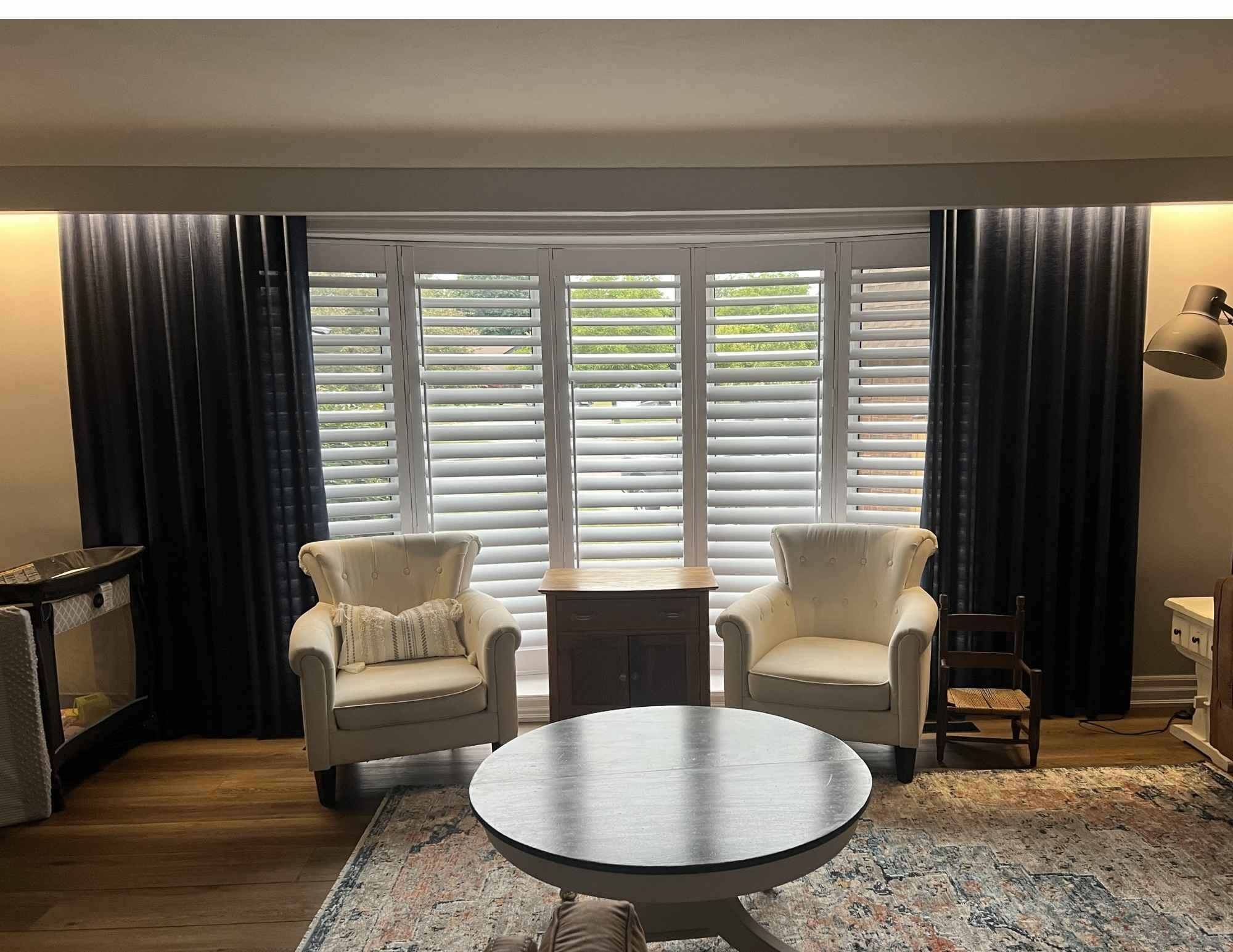
In the living room above, shutters run across every window of the bay with the louvres tilted open, and dark drapery panels hang on the wall either side. Shutters on a bay are normally built with a frame for each window, so the louvres on one window tilt without touching the next, and when a side window needs to open its panels swing out of the way.
The wide centre window is where material starts to matter. Wood is lighter than vinyl, so wood panels can be built wider before they need a vertical break, and that keeps the view across the middle of the bay cleaner. Vinyl is the safer pick in a kitchen bay over a sink. We go through the trade-offs room by room in wood vs vinyl california shutters.
If you are pricing california shutters for a living room bay, the number comes from each window's size and the material you pick, and we measure every opening in person before we quote it.
One shade on each window
Shades work well on bays because each window goes up and down on its own. Drop the two side shades when the sun comes in at an angle and leave the middle one up, or pull them all down at night.
On a bay that faces the street, top-down bottom-up shades are worth a look. You drop the top of the shade to let daylight in over head height and leave the bottom half covered, which is usually where the privacy problem is on a front bay.
Blinds on a bay
Wood and faux wood blinds suit a bay too, one blind per window. An inside mount needs enough casing depth for the headrail to sit flush, and on an outside mount we check the corners, because tilted slats can catch the blind on the next wall.
Drapery around the bay
The simplest way to add drapery is what you see in the living room photo, panels hung on the wall either side of the bay while the shutters handle light and privacy on the windows themselves. You can also run a rod or track shaped to follow the angles so the drapery closes right across the bay, though that means measuring those angles carefully. Our post on custom drapery for Niagara homes covers fabric and lining choices.
What we check on a bay at the consultation
The casing depth on every window, first, since that decides between inside and outside mount. Then the angles and any cranks or handles. Older homes around Niagara-on-the-Lake and St. Catharines add another layer, because original trim and framing that have shifted over the years change what will mount cleanly. Ian Martin, one of our design consultants, has more than 25 years in construction and window covering work, and his background is in exactly that, framing, trim and how things mount.
The consultation is free. We bring samples and measure each window in the bay, and the quote carries no obligation.
Common questions
Should a bay window have one covering or one per window?
One per window, in most cases. Separate coverings let each window open, tilt or raise on its own and avoid clashing at the corners. The exception is drapery, which can hang either side of the bay or run across it on a shaped track.
Can california shutters go on a bow window?
Often, yes, because a bow is made of several flat windows and each one can take its own shutter. The curve decides how the frames meet, so it is something we check in person before quoting.
Do you serve my area?
We serve St. Catharines, Niagara Falls, Niagara-on-the-Lake, Fort Erie, Smithville and the surrounding Niagara communities, with free in-home consultations.
To have a consultant look at your bay, call (905) 650-3210 or book through our St. Catharines blinds, shades and shutters page.