
Cellular Shades or Drapes for a Farmhouse Near Iowa City?
A lot of farmhouses get one thin curtain on the windy side, and the room stays cold anyway. If you're weighing cellular shades in Iowa City against drapes for an old country house, I'd use both on the north and west windows. Put the shade against the glass and a lined drape over it. The sunny south side usually does fine with the shade alone.
Out around Lone Tree and Riverside, that split covers most of what an older farmhouse needs.
What makes a farmhouse window so cold?
Wind is most of it. In town, the houses and big old trees on every block break it up before it reaches your windows. Out on a farm lot there's often nothing between the fields and your living room window. Farm families plant rows of trees to block it. Iowa State's extension service tells them to put those rows on the north and west sides. That's the side the winter wind comes from. Maybe your farmhouse lost its old tree line. Maybe it never had one. Either way, the north and west windows take the full hit.
The cold itself is steady. It lasts for weeks, and the north side of an old farmhouse feels every one of them. NOAA normals put the January low in Iowa City at about 12 degrees. The glass gets cold and chills the air beside it, which slides down the wall and pools along the floor.
Old windows bring their own trouble. Sashes loosen over the years, and old outer windows go missing or don't close right. On a windy day, run your palm slowly around the sash before you buy anything. If you feel real moving air from outside, the window needs weatherstripping or repair first. A cool zone near the glass with no real breeze is the part a shade or drape can fix.
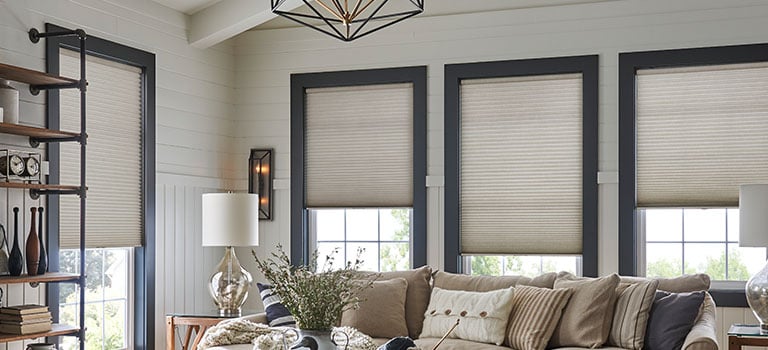
What are cellular shades, and how do they handle old glass?
A cellular shade is pleated fabric folded into rows of little pockets. From the end it looks like a honeycomb, which is why some people call it a honeycomb shade. What matters out here is simpler: cellular shades help with cold glass, and they sit close to the window.
On the north and west glass of a farmhouse I'd go double cell, with a second row of pockets. A sunny south window does fine with single. You can pick a cordless, top-down/bottom-up or motorized lift.
The other question on an old farmhouse is the frame. If it's shallow, an inside-mounted shade has little room and leaves more open glass at the sides. On a frame like that, mount the shade higher up and let it overlap the trim. You lose a little of the woodwork when the shade is down, but it covers the sides of the glass better. Our cellular shade options list the light levels and lift styles.
Are curtains or cellular shades better for a cold room?
It depends on how the curtains are made and hung. A lined drape that closes tight can help as much as a shade on a windy wall. A thin curtain hung on a rod a few inches off the wall does almost nothing, since cold air just drops behind it and spills out the bottom.
For a drape to really help, I look for four things. It has a thermal lining. The rod sits above the window and runs past the frame on both sides, so the closed panels cover the trim. The panels overlap in the middle. And the drape reaches the sill or the floor with no big gap underneath. Our drapery choices include standard, thermal and blackout linings.
Drapes have a downside you can miss until the first cold night. Does your farmhouse have radiators or floor registers right under the windows? A floor-length drape over a heat source blocks the warm air from ever reaching the room. On those windows, stop the drape at the sill. Or skip it there and use a double-cell shade alone.
The shade has a downside too, since it only covers the glass and the frame. A wide drape also closes off the wall around a leaky old frame, so the windy side gets both.
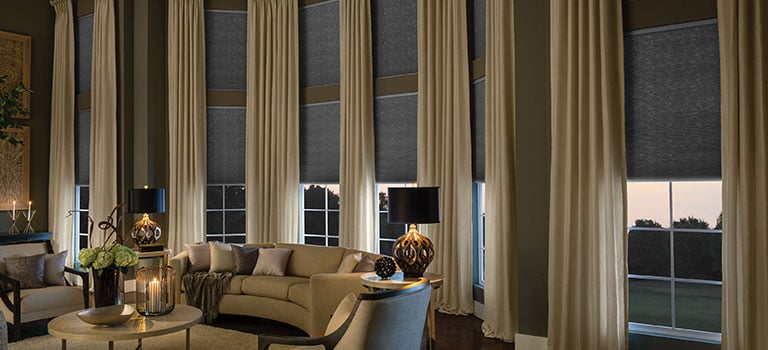
Cellular shade, drapes or both: room by room
Say your farmhouse faces open fields on the north and west. The rooms split up like this.
| Room | My pick | Why |
|---|---|---|
| North or west bedroom | Double-cell shade plus lined drapes | Takes the wind and is used all night |
| Living room facing the fields | Both, with drapes open by day | Long evenings by the window |
| South-facing front room | Single-cell shade only | Sun warms it on clear days |
| Kitchen | Faux wood blind, no drapes | Handles steam and splashes at the sink |
| Upstairs dormer window | Cellular shade, outside mount | Little wall space for a rod |
| Room with a radiator under the glass | Shade, or drapes cut to the sill | Keep heat moving into the room |
The habit matters as much as the product. Open everything on the south side when the sun's out, even on cold days. Close up at dusk, which comes well before supper out by Lone Tree in early December. In a cold snap, leave the north and west shades down most of the day and pull the drapes shut at night.
Start with the wall that faces the field
For the order, go by wall more than by room. Start with whichever side of the house looks out on open ground, because that's where the wind lands. Do every window on that wall in one pass. The south side and the rooms tucked behind a shed or a tree line can wait a season.
Old houses in town face the same short days. We wrote about keeping older Goosetown and Longfellow rooms bright in winter, and most of it applies out here too. If a reading chair sits by one of the field windows, our post on Roman shades for an Iowa City reading nook covers a softer look for that spot.
The first window I'd do out here is the north or west bedroom. It takes the wind, and you sleep a few feet from it all night. Ask for that window first when you set up a visit about cellular shades in Iowa City.
Kevin Sill is CFO and co-owner of the family-owned Budget Blinds franchises serving the Iowa City area.