
Iowa City Plantation Shutters: 7 Questions for Hills Homes
After the clocks fall back, the front window is the one that gives a house away. The lamps go on before supper, and a lit room shows clearly from across a quiet street. That's the window where I like plantation shutters, in Iowa City and eight miles south in Hills. They close tight for the evening and tilt open for daylight, though on their own they won't make a bedroom dark enough for a late sleeper.
1. Why does the front window matter more in November?
All summer the front window takes care of itself, because it's still light out when most people sit down to eat. In Hills it's dark before five by mid-November, so that cover is gone. A lit room behind bare glass is easy to see into from the street, even for someone just walking the dog. People don't mean to look, but they do.
Shutters suit that window. Closing them takes one easy motion. You push the tilt rod up or down, and every louver in the panel turns with it. There's no fabric to lower and no rail to reach for.
Close the front room every evening. The back rooms can stay open a little longer if they face a yard, since nobody walks past back there.
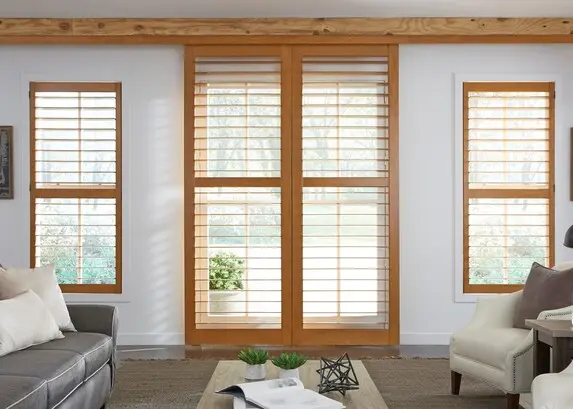
2. How should the louvers sit, day and night?
By day, privacy comes down to the tilt. Sit in your usual chair and turn the louvers a little at a time. When the people on the sidewalk are out of sight from that seat, leave the louvers there. In daylight a passerby sees mostly louver, and the room stays bright.
Once it's dark, shut every panel. The louvers lie flat against each other and hide the room well. A little lamp glow may show at the seams from outside, but nobody can make out who's on the couch.
Don't trust a half-open louver at night. The angle that looked private at noon shows a lot more once the lamps are on inside and the street is dark. For keeping the room bright right up to supper, the winter light rules from Goosetown and Longfellow cover the late afternoon.
3. Which louver size fits a small-town front window?
Louver sizes vary. Match the size to the glass in front of you before you think about any photo you liked online.
On a wide picture window, go with a larger louver. Tilted open, it keeps more of the view clear and suits the size of the glass. On a short or narrow window, go smaller. A small panel with only a few wide slats looks clumsy.
An older window that's a little out of true is fine because each shutter frame is built to fit its own opening.
4. Wood or composite, and which rooms get which?
You can get plantation shutters in real hardwood or in polymer faux wood. Vinyl, composite and hybrid are options too.
Keep real wood to the dry rooms: the front room, the dining room and a den. In a bathroom or near the kitchen sink, composite is the safer pick. It's a polymer with a polypropylene finish, made to hold up in humid rooms where wood would swell.
Color is usually the easy part, because the trim you already have makes most of the decision for you. Painted trim calls for a painted shutter in the same white, and stained trim can take a stained wood shutter. We bring shutter samples right to the window so you can hold the white or the stain against your own trim.
5. Are plantation shutters still in style, or are people pulling them out?
They're still in style. I'd put them in my own front room. The look is plain and calm, and it doesn't lean on a color trend that will feel dated in a few years.
When shutters do come out, it's usually because they went on the wrong window. Hinged panels on a busy back door get in the way every time someone heads outside. Real wood in a steamy bathroom can swell and stick until the panels never quite open the way they used to. A bedroom that someone expected to be pitch dark still lets in morning light.
Each of those is a planning problem. Put shutters where they suit the window, and they tend to stay for a long time.
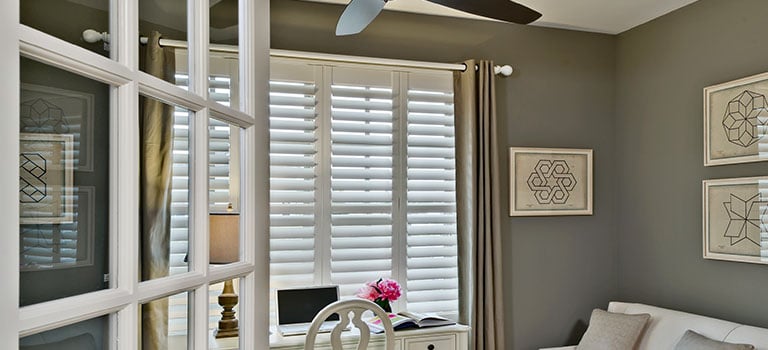
6. What won't plantation shutters do?
They won't make a bedroom fully dark. Closed louvers block most of the light, but thin lines of it still show where the louvers meet. For a late sleeper, hang room-darkening drapes on a rod above the shutters. Or skip shutters in that bedroom and pick a room-darkening shade.
They also do less for cold glass than some shades. If a bedroom window feels drafty in January, a cellular shade may be the better fit for that one window.
Shutter panels swing out when you open them, so leave a few inches between the window and any lamp or chair. Pick a color that works with your trim and floors too, since shutters aren't a quick swap.
7. Where would I start in a Hills house?
Start with the room that faces the street, and do every window on that wall at once. Shutters look best as a matched set from the sidewalk, and a half-done wall looks like you ran out of time. The back rooms can follow whenever you like, and they don't all have to be shutters. A family room with a TV may do better with a solar shade, which our game-day glare post walks through.
Materials and louver choices are on our plantation shutters page. Is the front window facing your street the one that bothers you every evening? Ask us over to look at it for plantation shutters in Iowa City. We'll plan the rest of that wall around it.
Kevin Sill is CFO and co-owner of the family-owned Budget Blinds franchises serving the Iowa City area.