
Sliding Glass Door Blinds in Iowa City for Busy Back Doors
For a busy patio door, I'd pick something that slides sideways like the door does. Around Coralville and Iowa City, most busy sliding glass doors do best with vertical blinds, a sliding panel track or a vertical cellular shade. All three stack off to one side, so you walk right through. A solar roller shade only makes sense on a door that's used less and gets a lot of sun.
Which one is right depends on how your family uses that door. So start there.
Count the trips first
In a lot of Coralville homes, the back slider is really the front door. The town is laced with trails and extra-wide sidewalks. Live near one and the dog walk starts at the back door. So do the bike rides and the trips to the grill.
April makes it worse. Everybody heads back outside in one of our wetter months. That means a lot of muddy paws across the deck.
So before you look at fabric, count. Does the door open twice a day or twenty? Does the dog use it on his own schedule? Do the kids leave it open behind them? A door that opens all day needs a covering that's out of the way all day.
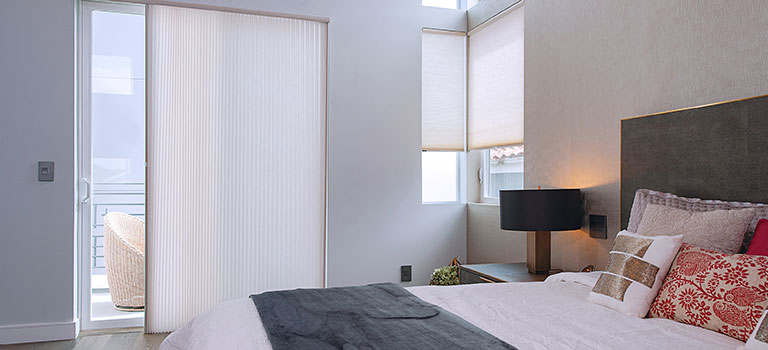
Four sliding door options
Each one has a catch.
Vertical blinds hang from a track. They tilt to let light in and slide aside to open. They move the same direction as the door, which is why they've been the standard for so long. Vinyl vanes stand up to pets and busy rooms and wipe clean. The catch is the look. Some people still picture the clacking vanes from years ago. Fabric and textured vanes look a lot softer today, and an S-shaped vane hangs more like a drape.
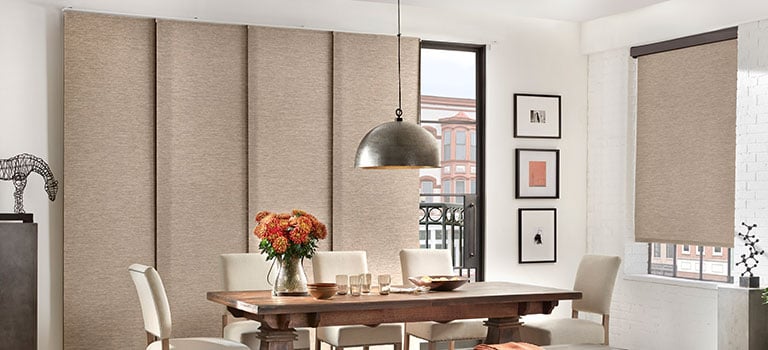
Sliding panel tracks are wide flat panels that glide on a track and overlap a bit, so there aren't gaps between them. They look clean and modern. You can get them in regular fabric, solar fabric or woven wood. The catch is the stack. Wide panels take up some wall or glass when they're pushed aside, so you need room for them.
Vertical cellular shades are the honeycomb fabric of a regular cellular shade, turned on its side. They open left, right or from the middle. Those cells trap air, so they help the most on a door that feels drafty in January. The catch is that it's fabric, and a wet dog shaking off right next to it isn't ideal.
A solar roller shade is one wide shade that rolls up from the bottom. It cuts glare and still shows you the yard. But it's the only one here you have to raise before you walk through. On a door the family uses all day, that gets old fast.
Sun, shade and night
Once you know the traffic, look at the sun. A west or south door gets afternoon glare in spring and summer. A panel track in solar fabric gives you glare control and a side stack in one. An east door is bright at breakfast and calm the rest of the day, so verticals or a light-filtering panel track are plenty. A north door gets little sun but is often the coldest glass in the house, and that's where I'd lean toward a vertical cellular shade.
Coralville has been losing its ash trees for years. Emerald ash borer showed up in town in 2017, and the city expects to lose most or all of its ash. If a big ash used to shade your deck, that door may be getting a lot more afternoon sun than it used to.
That's where solar fabric makes sense. It cuts glare and keeps a bit of the afternoon heat out, and you can still see the yard. You pick it by openness, the percent of the weave that's open. A low number gives you a tighter screen with more daytime privacy. A higher one shows more of the yard. On a door that lost its tree, I'd lean toward the tighter end. Homes built in the 2000s often have this glare problem anyway, and our North Liberty homes by decade post gets into why.
The one thing to know about solar fabric is that with the lamps on at night, the yard can see in. On a door you walk through all day, I'd skip anything that rolls up for night too. A solar panel track with drapery panels on a rod handles both.
Which side should it stack to?
Stack it toward the panel that doesn't move. Most sliders have one fixed panel and one that slides. If the covering stacks over the fixed side, the open doorway stays completely clear.
A split stack opens from the middle, like curtains. It works on an extra-wide door or one that opens from the center. If the family always uses one side, a split stack just means pushing two things aside.
Check the handle too. A handle that sticks out can catch a covering hung too close to the glass.
Measuring and installing
Doors are a little different from windows. Most door coverings mount above the frame instead of inside it, so look up first. Note which panel slides, how far the handle sticks out and how much wall there is above the trim. Look for a light switch, a vent or a corner that could block the stack on one side. If the door is wider than standard, custom sizing handles it. We do the install ourselves, and we set the track so the door still slides freely.
If you're in a newer townhome, door glass and narrow windows bring their own sizing questions. Our townhome sizing answers cover them. You can also browse our sliding door options.
Samples tell you more at a patio door than anywhere else, because you can slide them and walk through them. The consultation is free, and we'll bring a few. Our local page has more on sliding glass door blinds in Iowa City and Coralville.
Kevin Sill is CFO and co-owner of the family-owned Budget Blinds franchises serving the Iowa City area.