
Top Down Bottom Up Shades in Iowa City for Solon Acreages
On an acreage near Solon, almost nobody can see in. The sun and the view are huge, though. That's where top-down bottom-up shades do something different than they do in town. In the country homes north of Iowa City, I use them less for privacy. They're mostly there to control glare without giving up the view. You can open the top for sky light or the bottom for the fields. You can also leave a band of fabric across the middle at eye level.
How the top-down rail works
A regular shade only opens from the bottom. This kind has a moving rail at each end, and you control both. Lower the top rail and the top of the window opens, so light comes in over the fabric. Raise the bottom rail and the bottom of the window opens like any shade. Move both, and the fabric sits as a band wherever you want it.
Our cellular shades offer this option. So do our pleated, Roman and woven wood shades. Roller shades don't.
Out here, glare is the bigger problem. In town the house next door blocks some of the sun. On an acreage nothing does, and you get bounce off snow in winter and off a bright yard in summer. Around Solon, the back windows look at fields and timber. The woods and prairie at the state park just west of town bring ospreys and waterfowl through in spring and fall, and nobody wants a shade that hides that.
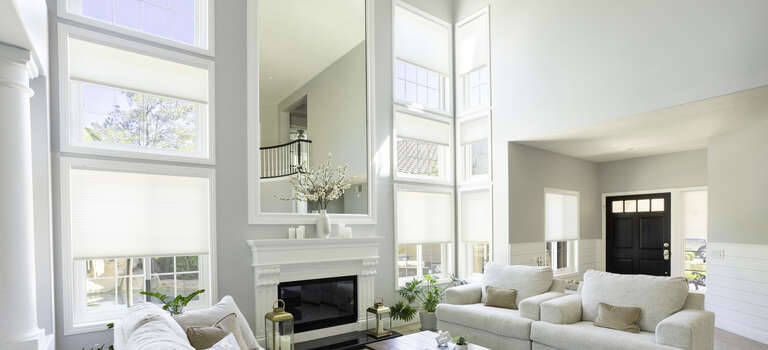
The big view window
Start with the window you look out the most. Usually it's a wide living room window or a bay facing the back, the one you'd stand at with your coffee to see what's out in the field. I'm picturing one that faces south or east here. A big west window is a different job.
In the morning, raise the bottom rail all the way so nothing blocks the yard. Around midday when the sun's high, bring the bottom rail down a foot or two. The fabric then covers just the upper glass. That cuts the hottest light, and you still see out below it. In fall and winter the sun stays low in the southern sky, and in the afternoon it hits you at eye level on the couch. That's when the middle band helps most. Lower the top rail a little and the bottom rail a little more. Then slide the band until it covers the spot where the glare hits your face.
For fabric, I'd go light-filtering. It softens glare without making the room dim.
Try the band before you buy anything. Tape a bedsheet across the middle of the view window with painter's tape, about where your eyes are when you sit. Leave the top and bottom open, and sit there at the worst time of day. If the glare's gone and you still see out, a top-down shade will work on that window.
One window in a lot of acreage homes is a big west wall of glass. Summer evening sun there heats the whole great room and glares on every screen. That's where I'd skip the top-down shade. A solar shade cuts the low western glare and takes some heat off the room. You keep the view with it down. Plenty of country homes use both, with solar on the west glass and top-down cellular everywhere else.
Bedrooms, the kitchen and the road side
In late June the sun's up around 5:30, and there's no house next door to block it. An east bedroom gets that first light right on the bed. For sleep, I'd pick a room-darkening cellular shade and keep it closed overnight. If you also want sky in the morning, ask us whether the top-down option fits that window and fabric. Then you can lower just the top rail a few inches without full sun on the pillow.
The kitchen window often faces the drive. You want light while you work and a view of who's pulling in. I'd keep the shade open most of the day. During the hottest hours, bring the bottom rail down partway so the fabric covers the upper glass. If the window is right over the faucet, splash is hard on fabric. Ask about a hard-surface blind there instead.
Windows facing the county road are the one place privacy comes back. With no streetlights it's pitch black outside at night. A lit room shows clearly from the road, and light-filtering fabric only blurs it. For those windows, pick room-darkening fabric or add drapery panels you close at dusk. During the day, lower the top rail for light and leave the bottom rail at the sill. People driving by just see fabric.
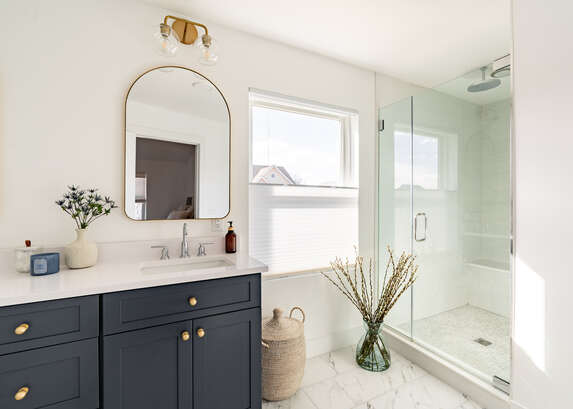
Warmth on cold nights
People often ask whether curtains or blinds are better for holding heat. On a cold acreage night, neither wins on its own. A cellular shade's honeycomb holds a layer of air right at the glass, and you can pick single or double cells. Drapes with a thermal lining add a second layer in front of that. Together they do more than either one alone. In a big living room I'd put a top-down cellular shade inside the frame and lined drapery panels on a wide rod outside it. If you like a softer look, Roman shades come top-down too. Our post on Roman shades for a reading nook shows how they look by a reading chair.
On sunny winter days, lower the top rail on the south windows and let the low sun in. Then close everything at dusk. Older homes in town get the same advice, and our winter light rules for Goosetown and Longfellow go deeper on it.
Tall glass up near the peak
A lot of country houses have a tall great room with windows near the peak. Those are a pain to reach, so I'd go motorized there. One button moves the high shades with the low ones. Angled windows up in the peak are everyday work for us, so the shape shouldn't put you off either.
We'll drive out for a free consultation. We measure everything from the tall great room glass to the little window over the sink. You'll have a clear quote before we head back down the gravel. Our local page has more on top down bottom up shades in Iowa City and the country around it.
Kevin Sill is CFO and co-owner of the family-owned Budget Blinds franchises serving the Iowa City area.