
How to Measure for Blinds on Tall La Crosse Windows
The first thing I'd decide is where each blind will hang, inside the window frame or outside it. If it goes inside, measure the width in three places and use the narrowest. Then measure the height in three places and use the longest. Old frames are rarely square, so measure every window on its own, even the ones that look like twins.
That's how to measure for blinds in most older La Crosse homes. The rest is what trips people up on tall old windows like the ones in the Cass and King neighborhood. And if you'd rather skip the ladder entirely, that's fine too.
Why old La Crosse windows are tricky
Most of the houses in the Cass and King district went up between 1890 and 1930. So they've had a century to settle. The early ones are big Victorians, some with towers. Later came Prairie houses with leaded glass and bands of windows that wrap around a corner. One older house can hand you all of it at once. Settling pulls a frame out of square. The top of a tall sash is out of easy reach. The trim is deep and detailed, and you don't want new holes in it. Sash locks and crank handles stick out into the opening. It all just means measuring slowly.
You don't need anything fancy. Use a metal tape, because a cloth sewing tape can stretch. Bring a pencil and paper or your phone, and a sturdy step stool or ladder for the tall ones. A second person helps a lot, one holding the tape and one reading it. Name each window before the tape comes out. Try "front parlor left" or "upstairs hall by the stairs." Two windows in an old house can look identical and still be a quarter inch apart. If you number them 1 through 12, you'll mix them up by window 5. I would.
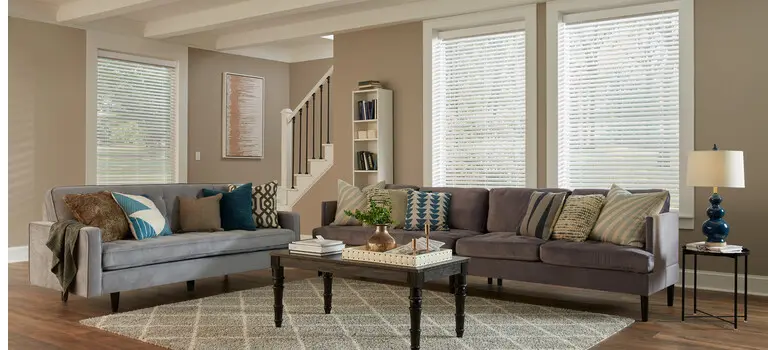
Inside the frame or outside it?
Both can be right. It depends on the window. An inside mount sits within the window opening. All the trim stays in view and it looks built in. In a house with beautiful old casings, that's usually what I'd want. It needs enough depth in the frame for the headrail, the bar along the top. It leaves a thin line of light at each side.
An outside mount hangs on the face of the trim or on the wall above, past the opening. It covers those side gaps and blocks more light at the edges. It also hides a crooked frame and can make a short window look taller. The trade is that it covers some of the trim.
A shallow frame doesn't always rule out an inside mount, because some products need less depth than others. A cellular shade is one good option for a shallow frame. If your heart is set on a product, write down your frame depth and we'll tell you whether it fits.
How to measure for blinds inside the frame
You'll take six readings per window, which goes faster than it sounds.
For the width, stretch the tape across the opening from one inside edge of the frame to the other. Those inside edges are the jambs. Measure near the top, halfway down and just above the sill. Write all three down. Use the narrowest, because a blind cut to the widest number won't fit through the tight spot. Say your three come out at 34 and 1/4, 34 and 1/8 and 34 and 3/8 inches. Your number is 34 and 1/8.
For the height, run the tape from the top of the opening down to the sill. Do it along the left side, through the center and along the right side. This time use the longest. A blind cut to the shortest number leaves a gap at the low corner. You'll see that gap every morning. On an inside mount, the bottom should reach the sill or come very close. Some old sills are deep and slope toward the outside. So the blind may rest a little above the low edge. That's normal, and it's something we'd check in person.
On tall sash, measure the top from the ladder instead of reaching up from the floor and guessing. The top reading is the one most likely to be off. Write fractions exactly rather than rounding, and label every number. If a sash lock or crank pokes into the opening, note how far. The blind has to clear it.
Then check the frame for square. Measure corner to corner both ways, like drawing an X across the glass. If the two numbers don't match, write both down. A frame that's well out of square can make an inside mount look crooked even when the blind is straight, and we'll tell you at the window whether an outside mount is the better call.
Last, measure how deep the opening is. Put the tape on the flat inside surface of the jamb and measure from its front edge back to the sash, or to the first thing that sticks out, like a lock. Leave the trim on the wall out of it. It isn't part of the opening, and counting it makes the frame look deeper than it is. Write the number to the nearest eighth of an inch. Every product needs a certain depth to mount inside, and we'll check yours against the one you like.
Measuring outside the frame
Start by deciding where it will fasten, because in an older house that matters most. You have two spots: the flat face of the trim, or the wall just above it. I usually like the wall above. It keeps screws out of the original woodwork and gives the raised blind somewhere to sit above the glass. For the width, measure where the blind will actually hang. Include the trim if you want to cover it. For the height, measure from where the headrail will sit down to the sill. Or measure to wherever you want the blind to stop.
How much extra on each side depends on the product and how dark you want the room. A bedroom usually wants more than a sunroom. So I wouldn't guess. Measure how much flat trim or wall you have on each side of the opening and write it down. We'll set the overlap window by window. On an outside mount, the blind can be longer than the window, and often should be. Hanging the headrail higher makes the window look taller. On an inside mount it should fit the opening.
Two more things get missed on tall windows. The stack is the bundle of slats or fabric that gathers at the top when the blind is raised. On an inside mount it sits over the top of your glass. That matters most if there's a leaded transom up top, the small window above the main glass. You don't want the stack in front of the prettiest part. An outside mount set above the frame moves the stack onto the wall. The other is reach. Our blinds are always made cordless, and on a very tall window motorized makes a lot of sense. You can see what that looks like on our blinds page.
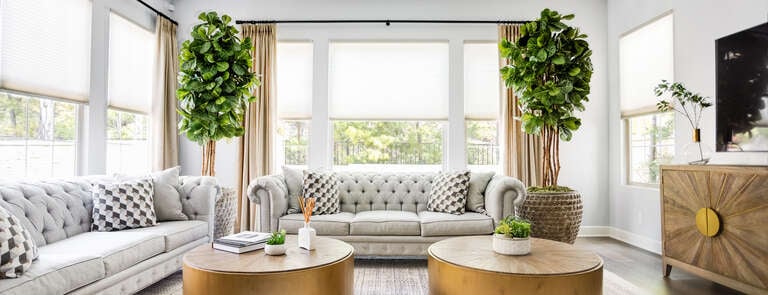
Towers, corner bands, leaded glass and old blinds
A round tower usually has a ring of narrow windows. Give each one its own line in your notes and check the depth on every one. A curved wall can vary from window to window. Where Prairie windows wrap a corner, measure each on its own and look at where two coverings will meet, so they don't bump when you raise them. With leaded or stained glass, ask yourself whether you want to cover it at all. If a leaded panel sits above a plain sash, cover just the plain part below. On an arched top that will stay open, measure only the square part below the curve. If you want the curve covered, leave that one to us. For bays and arched tops, our post on Roman shades for Victorian windows in Winona and La Crosse goes deeper.
If the old blinds are still up, measure the window, not the blind. Old blinds in old houses are often the wrong size, and the frame may have moved since they went up. If it's an inside mount, raise it all the way and measure the opening. If it's outside, decide whether to keep that spot or move up to the wall and patch the trim. Note any cracked trim or loose wood, since it's worth fixing first. Feel cold air around the frame while you're up there? Our post on drafty old windows in La Crosse and Winona covers what to check.
Your notes, or ours
You can also skip all of this. We measure every window ourselves before we order, even if you've already measured. Your notes are still a good way to get to know your windows and think through what you want. For the free in-home consultation, we bring fabric and color samples. You can judge them right beside your own woodwork. Our home page has more on how to measure for blinds in La Crosse and what a visit looks like.
If you do measure, I'd write one block like this for each window.
- The name of the window.
- Inside or outside mount.
- The three widths, with the narrowest circled.
- The three heights, with the longest circled.
- The depth of the opening, measured on the jamb.
- The two corner-to-corner numbers.
- Anything that sticks out.
- Any leaded, stained or arched glass, marked "cover" or "leave open."
If a number looks strange, measure it again. Then keep the page somewhere safe. The next time you replace a shade in that room, you won't have to climb the ladder again.
Kevin Sill is CFO and co-owner of the family-owned Budget Blinds franchises serving La Crosse, Winona and the Coulee Region.