
Roller Shades by Home Age: West Salem Homes Near La Crosse
In West Salem, the age of your house is a pretty good guide to which roller shade you need. Older homes near the village center often have narrow sash windows and deep wood trim. A slim roller shade mounted inside the frame leaves that woodwork in plain view. Newer homes have wide glass and open great rooms, and that's where I'd use solar shades. I'd pick roller shades the same way in La Crosse or Holmen, too.
West Salem has a little of everything. The village goes back to the 1850s, and it has grown a lot since the 1960s. So you can have hundred-year-old windows on one street and a brand-new great room two blocks over.
Older homes near the village center
In an older house, the trim is half the charm. I'd want a shade that stays out of its way. A roller shade is one sheet of fabric on a tube. Raise it and it rolls into a small bundle at the top of the frame. You see the glass and the casing instead of a thick stack of fabric.
A few small choices make a roller look right in an older room. I'd pick a fabric with some texture, like a linen look or a soft weave. A shiny fabric can look out of place next to old wood. A fabric-wrapped cassette keeps the top neat. That's the small cover over the tube. For the bottom edge you can go straight, rounded or scalloped. I like a scalloped hem in an older house.
Should the shade go inside the frame? Usually, yes. Inside mount looks clean and leaves every inch of trim in view. The frame just has to be deep enough for the tube. You'll see a sliver of light down each edge. Outside mount hangs on the trim face or the wall, a little wider and taller than the opening. Those slivers go away. A lot of older homes have deep casings, so inside mounts fit easily. Old frames are rarely square, though. Run the tape across the top of the opening, then the middle and then the bottom. Use the narrowest. If those three numbers are way off from each other, the frame may be happier with an outside mount.
Feel a chill coming off those old windows? Fix the window first, because no shade stops a leak. We wrote about lined drapes and leaky sash in older homes, including what to look at before you buy anything.
Houses from the '60s through the '90s
The windows get wider and lower in this middle group. Many of these homes have a big living room picture window. Some have a sliding door off the kitchen, and bedroom windows often sit higher on the wall. Rollers handle all of it.
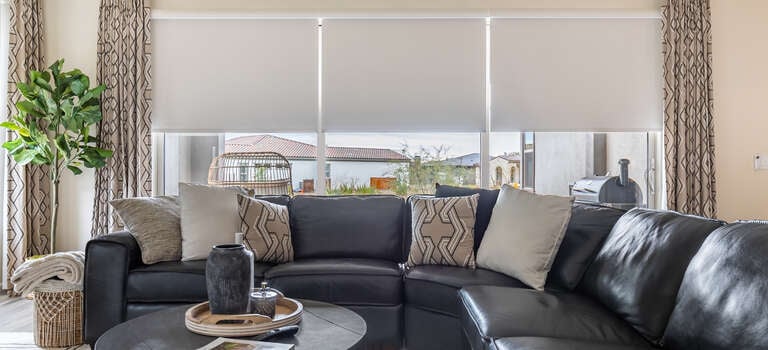
On a wide picture window, I'd use two or three shades side by side instead of one big one. They're easier to lift, and you can lower just the part where the sun comes in. Line up the hems and they read as one piece. On a slider you rarely use, a roller that rolls up clear of the door keeps the track free. The busy door everyone runs in and out of is another story. There I'd pick something that glides sideways, like a panel track or a vertical cellular shade. High bedroom windows are where motorized earns a look, since you won't stand on the bed every morning.
Newer homes and lots of glass
Big glass brings in a lot of light, and in March it brings in a lot of glare. La Crosse still averages about seven inches of snow in March. Fresh snow on a sunny day bounces light right into the great room.
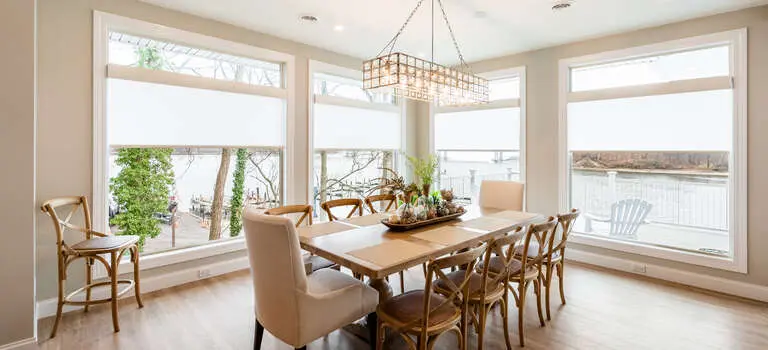
That's when I'd reach for a solar shade, a roller with screen-like fabric. It tames the glare and helps block UV, and in daylight the yard is still there through it. The main choice is how loosely it's woven. West windows get the worst of it late in the day, so I'd go tighter there. On south glass a medium weave is usually plenty, because the eaves keep most of the July sun off it.
With the lamps on after dark, anyone outside can see through that screen. In rooms close to the street or the house next door, drapes you pull at night are the easy answer. In a bigger new build? Our guide to Holmen move-up homes goes room by room, great room included.
Bedroom roller shades: room darkening or blackout?
The two fabrics aren't the same. Room darkening leaves the room dusky, with enough light to get to the hallway without bumping into anything. Most people are happy with that. Blackout stops nearly all the light that hits it. I'd go that way for a light sleeper, a nursery or anyone who works nights.
The light at the sides catches people off guard. A roller can't seal itself to the frame, so even blackout fabric tucked inside the opening glows along both edges. To get a bedroom really dark, mount the shade on the wall and let it run past the opening on every side. Side rails help too. They're narrow channels the fabric edges run in.
One look for the house, and the windows that need something else
Simple looks are what I see people choosing: plain or softly textured fabric in warm neutrals, with the hardware hidden. That's easy with rollers. Pick one fabric family for the main floor and change only how open or how dark it is from room to room. The living room gets a light-filtering version, the great room a solar version, the bedrooms room darkening. From the street it all looks like one house.
The fabric families are all on our roller shades page. Our home page covers roller shades in La Crosse and the towns around it, and the in-home consultation is free. Before we suggest anything, we'll ask how your family uses each room.
Rollers will handle most of the house, but I'd put something else on three kinds of windows. In a steamy bathroom, faux wood or vinyl blinds hold up to moisture better than fabric. Want the top open and the bottom covered? A cellular shade can do top-down bottom-up. A roller can't. On a really cold window, like a drafty old upstairs bedroom, I'd lean toward cellular too. The honeycomb cells trap pockets of air, which helps insulate the glass. In that room staying warm matters more than matching the shades downstairs.
Kevin Sill is CFO and co-owner of the family-owned Budget Blinds franchises serving La Crosse, Winona and the Coulee Region.