
What Top Down Bottom Up Shades Really Hide in La Crosse
On a house that sits close to the sidewalk, I'd pick a top-down bottom-up shade for the front room. You drop the top and the sky comes in, while the bottom stays covered where people walk past. On a close street in La Crosse or Westby, top down bottom up shades are hard to beat by day. At night, that open strip at the top turns into the weak spot.
Dropping the top works best in daylight
By day, a lowered top rail works. Someone on the sidewalk looks up at your window from below. Through the open band at the top they see your ceiling and maybe the top of a picture frame.
You can find the right height from your own chair on a sunny day. Sit where you usually sit and lower the top rail a little at a time. Keep an eye on what shows through the gap. Sky and treetops are fine. So is the roofline across the way, since nobody up there can see you. Stop as soon as the sidewalk, the street or a neighbor's window comes into view. Anyone standing there can see in, so raise the rail back a bit. That height is your daytime line.
Night is different, for two reasons. First, the open band glows. A lit room is easy to read from a long way off. Even a narrow strip of glass near the top gives a lot away. The angle is what surprises people. Someone right under the window looks up steeply and sees only ceiling. A neighbor across the street looks in at a flatter angle, so through that same band they see much more of the room.
Second, the house next door may have an upstairs window that looks down at yours from a few yards away. Through an open top band, that window sees straight into your room.
So the top-down trick is for daytime. Around Westby and La Crosse the sun is down by about 4:40 in mid-November. That's the time to bring both rails together. Light-filtering fabric still has a limit after dark. With a lamp behind it the fabric lights up, and shadows moving across the room show through. Pick room darkening for bedrooms and for any room you sit in at night.
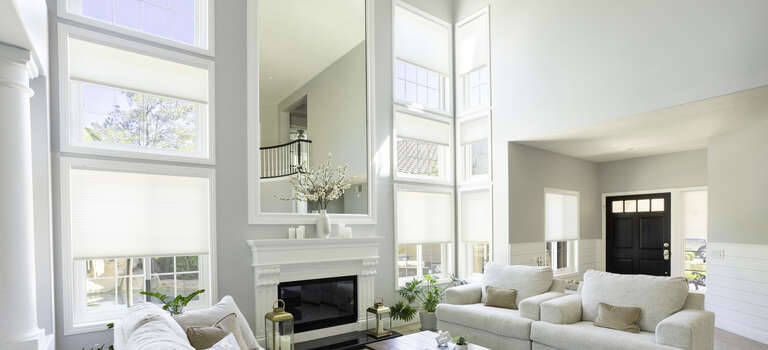
Only some shades open from the top
Cellular and pleated shades do, and so do Roman and woven. Roller, zebra and sheer shades don't. Like the clean look of a roller? A café shutter on the bottom half of the window gets you a similar effect.
Of the four, cellular is my first pick. It fits shallow old frames and comes in light levels from sheer to room darkening. The choices are on our cellular shades page. Roman shades with the top-down option suit a dressier front room. The Roman shade ideas for Victorian windows cover the folds. Woven shades can open from the top too, and their texture looks right on a bungalow with a lot of wood trim inside. They need a privacy or blackout liner before they'll do anything for you at night.
The front room is the place to start
Bedrooms and bathrooms are good spots for these shades, but the front room comes first. In an older house close to the street, the living room is often the one kept closed all day. A top-down shade lets you open it without feeling watched.
Old windows make this easy. Take this Westby bungalow on the state's historic inventory. It has four-over-one double-hung sash and a full-width front porch. On a window like that, drop the top rail to the middle bar where the two sashes meet. The divided panes up top stay open, and the plain lower sash stays covered.
A porch changes things. Someone on your steps stands only a few feet from the glass and closer to eye level. On a porch-side window, cover more of the glass so the open band at the top stays small. That matters even more once the trees are bare and the porch light is on. Hillside houses get it from above. The post on bluff homes once the trees are bare covers neighbors who look down from above.
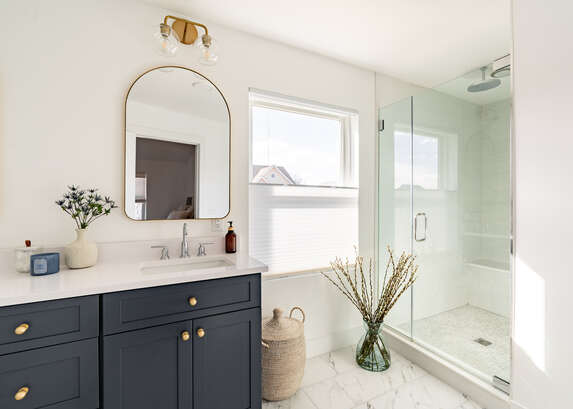
An open top leaves cold glass bare
With the top lowered, the strip of glass up there has nothing over it. On a cold November night, that strip of old glass is the first place you'll feel the chill. Our post on cellular shades for Coulee Region winters goes deeper on cold glass.
So set the shade one way for sun and another way for dark. On a sunny afternoon, leave the top open and let the sun warm the room. At dusk, close both rails so the whole window is covered. Closed all the way, a top-down cellular shade helps insulate the glass just like a standard one. A really drafty old window needs more than a shade, and insulated drapery over it is the next step.
Most old windows can take one
A cellular shade needs very little depth to sit inside the frame. That's why it fits so many old wood windows that won't take a bulkier shade without sticking out past the trim. The thing to watch is the hardware on the sash. A tall lock on the meeting rail or a crank can catch a shade that sits inside the frame. Then we mount it on the trim. We check each window's depth and hardware when we measure, and that decides the mount.
Tall old windows are the easiest of all. Most homes in La Crosse's 10th and Cass Streets Neighborhood Historic District went up before 1900, and the state notes tall arched windows on its Italianate houses. On glass that tall you can drop the top rail a long way before the open band gets near eye level. If the window has an arched top, leave the arch bare and fit the shade to the square part below it.
Before you call anyone, write down which rooms you actually sit in after dark. Those get room-darkening fabric, and the rest can stay lighter. Then call us about top down bottom up shades in La Crosse and we'll start with the front room.
Kevin Sill is CFO and co-owner of the family-owned Budget Blinds franchises serving La Crosse, Winona and the Coulee Region.