
A 5-Step Plan for Basement Window Coverings Near Madison WI
Most basements need two or three kinds of window coverings, not one. The small windows up high do best with a cellular shade, since it fits a shallow frame and folds up tight. The egress window needs a shade that lifts all the way clear with one push. A walkout window can take almost anything. That's the usual mix in a finished basement around Madison. The five steps below get you there one window at a time.
Step 1: Go down there on a gray day
In a lot of newer Verona and Windsor homes, the basement gets finished last. Often that's a year or two after move-in. That's actually a help. By then you know how you'll use the room, and the windows are easier to plan.
Before you think about fabric, walk down there on a rainy afternoon. That's when you'll see how dark the lower level really gets. Snap a quick photo of each window while you're down there.
You'll probably find three kinds.
First, the small windows set high in the wall. These sit right at ground level outside. You look out at grass, the side of a window well or the neighbor's siding. They don't let much light in to begin with, so whatever you put on them has to get out of the way when it's up.
Then there's the egress window. It's bigger, and it usually sits in a well dug into the yard. It's the one you'd climb out of in an emergency.
Last come walkout windows and patio doors. If your lot slopes, the back of the basement may be full height and open to the yard. These act just like main-floor windows. They get real sun, and people can see in.
Step 2: Find the egress window and keep it clear
An egress window is your way out in a fire. The window itself has to meet Wisconsin's dwelling code, and your builder and inspector take care of that part. Your only job is to make sure the window covering never gets in the way.
I keep this one simple. I want a shade you can push all the way up by hand in a second. That has to work in the dark and in a hurry. A cordless cellular or roller shade does that. When it's raised, it should clear the glass so nothing hangs in the opening.
I'd skip anything fixed across the glass, like a panel or a valance that hangs into the opening. I'd skip heavy drapery too. It's pretty, but not on the one window you might need to crawl through. And keep the desk or dresser away from that sill.
Before we leave, we run that shade up and down and make sure the window still opens all the way with it raised. Do the same check yourself once a year, and any time you rearrange the room. It takes a minute, and it's the one check down there that really matters.
While you're looking at that window, glance outside at the well. The covers that sit over window wells keep out snow, leaves and the odd critter. They're an outdoor product, though, and do nothing for light or privacy inside. If you're thinking about one over an egress well, ask your installer or building inspector how it works with an exit window before you buy.
Step 3: Decide what each room is for
The choices start to split here. The same small window can need a different shade depending on the room around it.
Family room or rec room. You want every bit of daylight, plus a little privacy. A light-filtering cellular shade works well on those high windows. Raise it all the way during the day, and you lose almost no glass. I'd skip the top-down option here, even though I like it upstairs. Someone standing in the yard looks down into a ground-level window. The top of the glass is exactly where they'd see in.
Lower-level bedroom. You want it dark in the morning. Even a small window lets in a bright beam at sunrise. I'd go with a room-darkening cellular shade. If whoever sleeps down there wants it fully dark, add block-out channels. Those are slim tracks down each side of the window that close the gap where light sneaks in.
Media room. Same idea, only more so. Glare on a big screen shows up even from a small window. I'd use a blackout roller shade with side rails, or the same channeled cellular shade as the bedroom.
Office. Here I'd do the opposite. A lower-level office is usually too dark, not too bright. One small window can't light your face on a video call, so let in all the daylight you can. Our post on video call glare and home office windows explains why the window behind you matters so much.
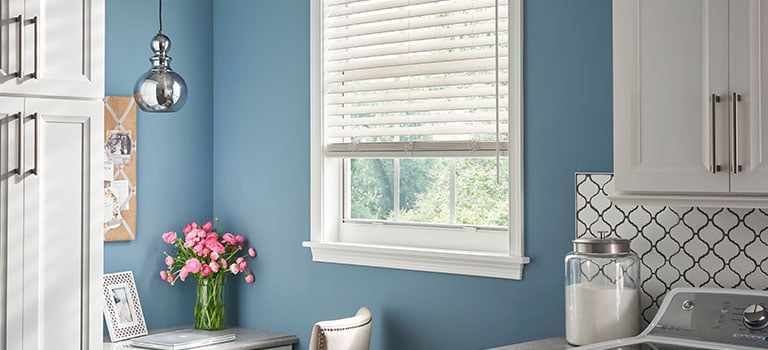
Laundry room and lower-level bath. These rooms get steamy, and fabric doesn't do well with that. I'd use faux wood blinds. They're made from a polymer that holds up to moisture and wipes clean. Our moisture-resistant window coverings are built for exactly these rooms. Real wood blinds and woven shades I'd keep upstairs.
A basement that runs a little damp in summer is a different story from a steamy bathroom. In a dry, finished room, fabric shades are fine. If a room smells musty or the windows sweat in July, I'd get a dehumidifier running and lean toward faux wood on those windows too.
Walkout rooms. The big question here is how to see out without anyone seeing in. During the day, a sheer shade does that well. It has soft fabric vanes between two sheer layers, so you keep the view and get some privacy. Close the vanes at night and the room is covered. A solar shade gives you the view by day too. After dark it works the other way around, and a lit room is easy to see from the yard. Our post on how much light-filtering shades show at night explains what a neighbor can actually see.
Step 4: Check how deep the frames are
Basement windows often sit in very shallow frames, and some are set right into the concrete. That limits what fits inside the opening.
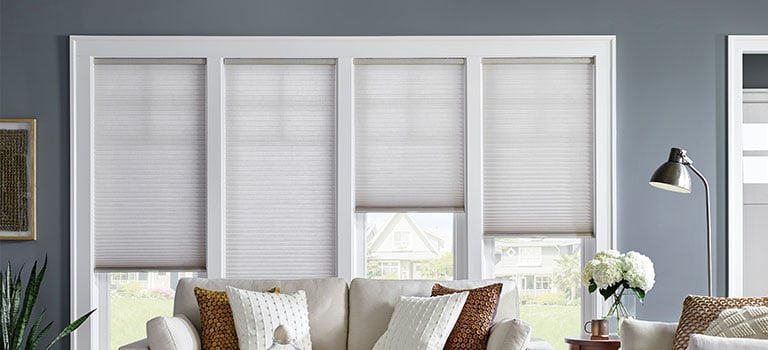
In a dry room, a cellular shade is one good answer here. It needs very little depth to sit inside the frame, and it folds up so tight that you barely lose any glass when it's raised. Some of these windows are short to begin with, so every inch of glass counts.
If the frame is just too shallow, mount the shade on the wall above it instead. Go a few inches higher and wider than the opening. The window looks bigger, and a rough or uneven frame gets covered up. It also blocks more light at the edges, which helps in a bedroom.
Look for crank handles too. Some basement windows have a handle that sticks into the room, and it can bump a shade mounted inside the frame. We'll check every window when we measure, but it's good to know what you're working with.
Step 5: Hold samples in basement light
Light down there is different. It's dimmer, and much of it bounces off the well wall or the ground before it gets to you. Colors shift because of that. A warm cream that looks great upstairs can turn flat and gray by the time it's next to a basement window.
So don't pick fabric upstairs. Hold every sample right next to the window you're covering. Look at it at the time of day you'll use the room, with the lights you'll actually have on. That's why we carry samples right down to the lower level when we come out for a free visit. We go window by window, from the egress well to the patio door. Light levels and colors for the small windows are on our cellular shades page. Our home page has more on basement window coverings in Madison and how the free visit works.
If you can't finish the whole basement now, that's fine. Most lower levels end up with a cellular shade on the small windows, something simple on the egress window and a separate pick for the walkout. Start with the bedroom and the egress window, since those two do the most for safety and sleep.
Kevin Sill is CFO and co-owner of the family-owned Budget Blinds franchises serving the greater Madison area.