
Which Window Treatments for Large Windows Suit Madison?
Before I suggest anything for a big window, I ask what the glass has to do after dark. Then I ask about sun, and about the view. That's how I'd work through window treatments for large windows in a home around Madison. Most end up with a sheer shade, a solar shade or a shade with drapery over it. Those three questions tell you which.
Night first, then sun and view
A big window is easy to love during the day. You put it in for the light and the view. Once the sun goes down and the lamps come on, the same wall of glass works like a lit stage.
So the first thing I want to know is who could see in after dark. If the window faces woods or a trail with nobody around, you might not care at all. If it faces the street or a neighbor's deck, you will.
Around Middleton and Verona, a lot of back yards run into a trail or protected prairie and conservancy land. Those windows often face nobody, and night privacy barely matters. A front window on a newer street is usually the opposite.
Next, does direct sun hit the glass for more than an hour or two? In August a west window takes the evening sun low and flat across the dinner table until after 8. A window like that needs real glare control.
Last, do you want to see out while the covering is down? Some people want the yard in view all day. Others only care about soft light.
Put the three answers together and most windows land in one of five spots:
- View wanted, gentle sun: a sheer shade.
- View wanted, strong sun: a solar shade.
- View by day, cover at night: a sheer shade with the vanes closed at night, or a solar shade with drapery.
- No view to keep, lots of glare: a light-filtering roller or a cellular shade.
- All of it matters: a shade for the day and drapery for the night.
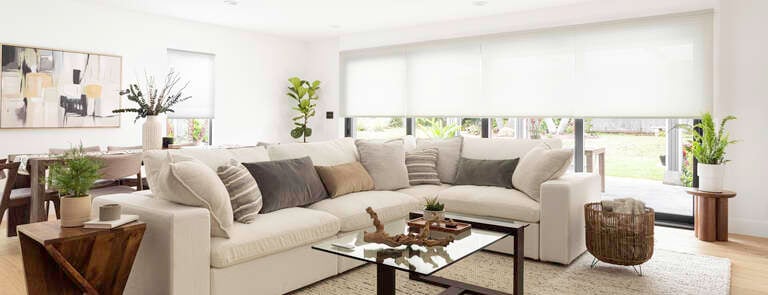
Sheer shades or solar shades
A sheer shade has soft fabric vanes held between two layers of sheer fabric. Tilt the vanes open and you look out through the sheer while the light comes in soft and even. Close them and the window is covered, with full privacy at night.
That makes them my usual pick for a big living room window that faces a yard, a field or a trail. You look through it all day, and the room never feels closed in. They're light enough to raise easily on wide glass, and when they're up they tuck into a headrail shaped like a small valance.
The one place I'd hesitate is a west window that takes hard evening sun. There I'd compare a sheer with a tight solar fabric before deciding.
A solar shade is a roller shade woven like a fine screen. You keep a slightly softer view, and the glare drops a lot. The weave comes tight or loose. Tight cuts more glare and shows less of the yard. Loose shows more view.
I'd go tight on a window that bakes and more open where the view matters most. Solar fabric also comes in wide widths, which helps on big glass because you need fewer shades and fewer seams.
Night is the weak spot. A solar shade hides the room only while it's brighter outside. If that window faces a neighbor, plan a second layer from the start. Our post on privacy after dark with light-filtering shades explains what people outside can and can't see with each kind of fabric.
No view to keep, or two jobs to do
Some big windows face the house next door. If you don't need to see out, a light-filtering roller or a cellular shade works well. You get a soft glow, less glare and daytime privacy. After dark, a lit room behind light-filtering fabric shows a silhouette, though not much detail. That's fine in a room nobody uses at night, and not great in a front room you sit in every evening.
A top-down bottom-up cellular shade is worth a look on a window like this. Lower it from the top for sky and light, and the bottom half stays covered where the neighbor's window lines up with yours.
When one window has to handle sun by day and privacy at night, I'd layer. The shade handles the daytime light. Drapery closes at night, adds warmth and softens all that hard glass.
Our drapes come with standard, thermal or blackout linings. They're made to fit your window. That matters on big glass, where ready-made panels rarely come long or wide enough. The header styles are on our drapes page. A ripplefold top looks clean and modern. Pinch pleats feel more classic.
Side panels around a sheer shade are one of my favorite looks on a big wall of glass. The panels stay open as a frame and add color. For a room that runs cold in winter, I'd put thermal drapery over a cellular shade instead.
If you love a strong color, put it in the drapery and keep the shade soft. Shades on big windows show from the street, and a calm color there keeps the house from looking busy.
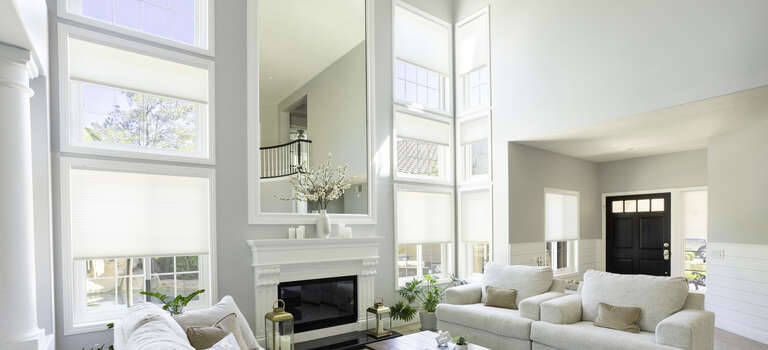
Picture windows, corners and two-story glass
A single big picture window is usually the star of the room, so keep it simple. One wide shade looks calm if the width works. If it takes two or three, line up where the shades meet with the dividers in the window. That way the breaks look planned.
A wall of separate windows does better with a shade on each one. Use the same fabric and mount on all of them so the wall still reads as one piece. The trim between them stays in view, and you can lower only the one taking the sun. Corner windows are similar. Use the same fabric on both sides and keep them at the same height, or the corner looks crooked from across the room.
A lot of people leave a transom bare. It lets in sky light even when the shade below is down. If it lets in glare, we can look at the shape in person and figure out what fits.
Sliding patio doors are big windows you walk through. Pick something that gets fully out of the way when the door opens. A sheer or solar shade can work, and so can drapery that slides all the way clear.
If you can't touch the top of a window from the floor, I'd motorize it. A tall window you can't reach is a window you won't adjust. Sheer shades, solar shades and drapery can all be motorized and run from a remote, a wall switch or your phone.
A motor helps with more than reach. A shade on a schedule can come down when the evening sun hits a west window and go back up after sunset. That's handy in August, when sunset keeps moving earlier and a fixed timer falls behind. If you're building or remodeling, plan the power early. Our guide to smart shades and Madison's daylight covers batteries, wiring and schedules.
Before you pick for a big window
Do this one thing first. Once it's fully dark, turn on the lamps you normally use. Walk out to the street or the back yard and look back at the house. The big windows that show the whole room are the ones that need cover at night. The rest can stay simple.
You can see the fabrics on our sheer shades page. Read more about window treatments for large windows in Madison and the towns we cover on our home page. Whenever it suits you, we'll come out for a free visit. Our team measures arches, angled tops, sliders and extra-wide windows all the time. Put the odd ones on the list too. When motorized shades go in, we run every one and walk you through the controls.
Kevin Sill is CFO and co-owner of the family-owned Budget Blinds franchises serving the greater Madison area.