
Bay Window Treatments for Older Rochester MN Homes
A bay window is really three or more windows sharing one nook. That's what makes it tricky. My usual answer is a shade on every panel in the same fabric. If you want softness, add drapes at the two outer ends. A top-down bottom-up cellular shade is the one I'd look at first. That's the starting plan for bay window treatments in Rochester, especially in the older homes on Pill Hill.
Look at what the bay is made of first
Start with the glass, before you think about fabric. Count the panels and look at the angles. Most bays have a wide center window and a narrower window on each side. Some have four or five panels in a curve. Write down what each panel does. Some open with a crank, some slide up and some don't open at all.
Then look at the room. Pill Hill's registered homes run from Colonial and Tudor revival to Prairie School and craftsman. If yours has deep wood trim around the bay, mount each shade inside its frame. That keeps the trim in view. A built-in seat changes the plan too (more on that below).
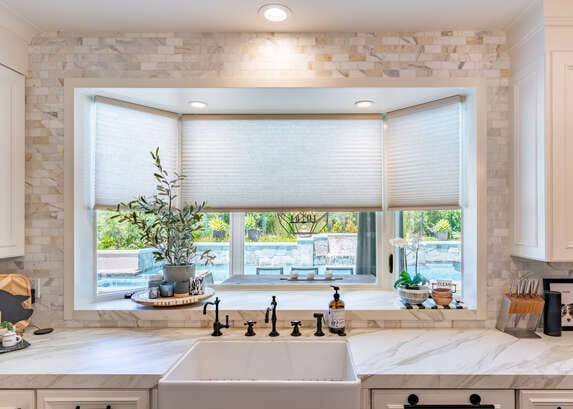
What kind of blinds can you put in a bay window?
Wood and faux wood blinds can go in a bay, as long as each panel gets its own. A shade usually does more for the nook, though. Our unique windows page shows the shapes we cover.
The most flexible pick is a top-down bottom-up cellular shade. You can lower the top of each panel for daylight and keep the bottom closed toward the street. A bay is mostly glass, and a shade that holds air against each pane does a lot of work there. Our post on single, double and blackout cells walks through which cell type fits a Rochester winter.
Roman shades give a softer, tailored look and suit a formal dining room. They come in top-down bottom-up too. The lined Roman shades post looks at them in the same older Pill Hill rooms. Each fold stacks at the top of its own panel, so check that the stack won't hide the top of a short window.
Wood blinds fit a den or a study bay with dark trim. They tilt nicely for light, but they don't hold much warmth at the glass on a winter night.
Shades on each panel or drapes across?
There are three ways to dress a bay, and I like the third.
One shade per panel is the cleanest. Each window opens on its own, so you can let light in the side panels and keep the center closed. Order every panel in the same fabric and set them all at the same depth. Closed, they should look like one band of cloth around the nook.
Drapes alone are the second way. A pair of panels at the outer ends frames the whole bay. They look rich, but they won't close across the angles on a plain straight rod. If you want drapes that close all the way around, motorized drapes can run on a curved ceiling or wall track. That's a bigger project, and it's best for a bay you close every night.
The third way is both. Shades do the daily work on each panel. Drapes at the two ends add color and texture, and they make the nook feel finished.
Plan for the cold corners
A bay puts three or more panes of glass around one small space. On a cold winter night it can feel noticeably colder than the rest of the room.
The weak spots are the corners where two panels meet. Each shade sits inside its own frame, so there's a small gap at every angle. Cold air from the glass spills into the room through those gaps. A cellular fabric helps, since it holds still air at each pane. It also helps a lot to close the shades before the glass chills the nook.
If you see frost or water on a bay window in the morning, that's a humidity issue as much as a shade issue.
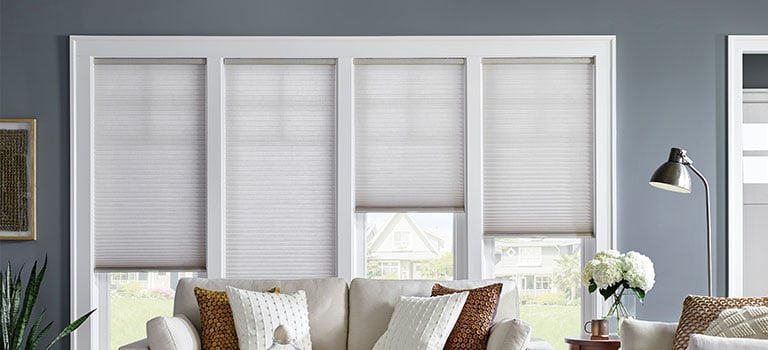
Check the seat, the cranks and the table
A window seat changes the plan. Shades on each panel should stop just above the cushion when closed. Drapes that frame the bay should stop at the seat too, or hang outside it on the wall. Floor-length panels that bunch on a cushion look messy in about a week, and nobody wants to sit on a fold of drapery.
On casement windows the crank handles stick out into the room, and an inside-mount shade has to clear every one of them. We check each one.
If the bay is in the dining room, think about the table for big family dinners too. Guests sit close to the glass, and late sun can land right on the table. Close the one or two panels on the sunny side and leave the rest open for light. Separate shades make that easy.
Replacing the bay windows first? Ask the city
The City Council made Pill Hill a local historic district in February 2025. New windows there now get city review before they go in. Shades and drapes hang inside the glass. The city's Pill Hill page lists no limits on inside changes that don't alter the outside look. If new windows are coming, plan the shades after they're in. The frame sizes will change.
A bay is where seeing the room in person matters most, since every panel and crank is a little different. We plan bay window treatments in Rochester one panel at a time, right there in the nook.
Kevin Sill is CFO and co-owner of the family-owned Budget Blinds franchises serving Rochester and southeast Minnesota.