
Basement Window Coverings Near Waukesha: Dousman and Wales
Basement windows have a tougher job than the ones upstairs. They're small and often high in the wall, and some sit in a well. The air can run a little damp. And in a basement bedroom, one window has to open all the way so you can get out. Around Waukesha, the basement window coverings I'd look at first are faux wood blinds, vinyl blinds and cellular shades. Which one goes where depends on the window and the room.
What kind of basement window do you have?
Go downstairs and look at each window before you think about color or fabric. Most lower-level windows fall into one of five kinds.
- The small window up high. It's short and wide. It sits near the ceiling, with its bottom edge at about ground level outside.
- The window in a well. The glass looks out at a curved metal or stone wall, maybe some gravel. Not much light comes in.
- The egress window. The bigger window in a basement bedroom, made big enough to climb out of in an emergency.
- The full-size window. On a lookout or walkout lower level, the windows can be as big as the ones upstairs.
- The walkout patio door. If you have one, it's often the biggest piece of glass in the basement.
Keep this in mind. Upstairs, people outside are below the window and look up. Down here they're above it. They stand in the yard or the driveway and look down into the room. So the top of a basement window is where people see in. That flips the usual privacy advice. It's why I don't use top-down shades on basement windows, even though I like them upstairs.
The egress window comes first
An egress window is your way out of a basement bedroom in a fire, so I'd plan its covering before anything else. In Wisconsin, the size of the opening and how high it can sit are set by the state's Uniform Dwelling Code. The window itself is the builder's job, and your inspector checks it. We don't size or install egress windows.
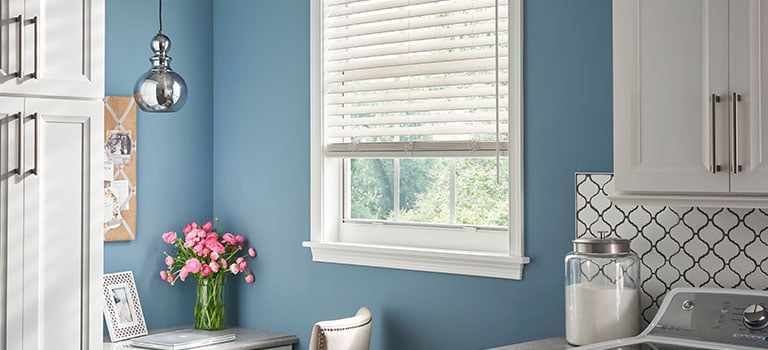
Our part is the covering, and on that window it has one job above everything else. It has to get completely out of the way in one quick move, with nothing to unhook and nothing to climb past. A cordless cellular shade works well in a dry bedroom because it stacks up very tight at the top. A cordless faux wood or vinyl blind works too, as long as it lifts clear of the opening. Open the window all the way before you pick. Watch how it moves. Some swing in, some crank out and some slide. The covering should never sit in the path of the sash or the handle.
How damp is it down there?
Some lower levels are as dry as the living room, and others feel cool and a little musty every spring no matter what you run down there. If you're not sure which you have, go down after a soaking rain. Spring is the real test around here, since April brings nearly twice as much rain and snow as March in a normal year. If it smells musty after the rain, go with faux wood or vinyl.
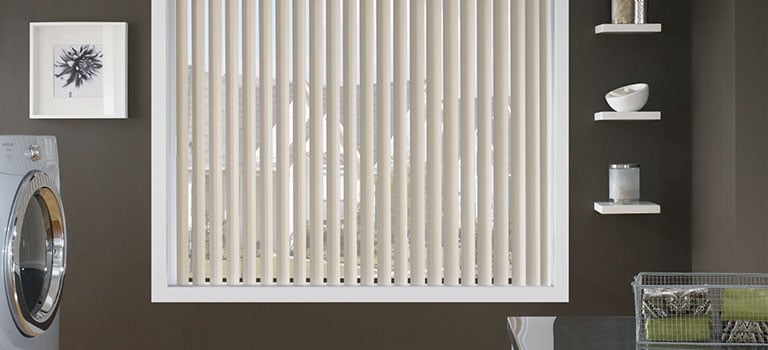
Faux wood blinds are made to resist moisture. They're my first pick for a lower level that hasn't proven it stays dry. Vinyl blinds are the plainer, tougher cousin. They're stain-resistant PVC, and they wipe clean with a damp cloth.
I'd keep a few things out of a damp basement. Real wood blinds can warp when the air stays humid. Woven wood shades are natural materials, and they belong in dry rooms. Cellular shades are fine in a finished room that stays dry, but I'd skip them anywhere that feels damp. A damp smell is worth looking into on its own, too. A blind can live with damp air. It won't fix it.
Room by room down there
In a dry family room, a light-filtering cellular shade keeps things bright and soft. If the window sits at ground level by the driveway, lower it all the way when you want privacy, and the fabric still lets daylight through. After dark that same fabric glows and gives you away. If you use the room at night, pick room-darkening fabric for the driveway window.
The media room is the one you want dark. If the room stays dry, my pick is room-darkening cellular fabric, with light guards or block-out channels added along the edges. Together they can make it completely dark. A blackout roller shade works too. Some roller fabrics are antimicrobial and antifungal, which is worth asking about down here. A basement bedroom's other windows get whatever passed the damp test, in a fabric dark enough to sleep.
A window well is often the dampest glass in the house, so I'd use faux wood or vinyl there. Close the blind when you want privacy, since people walking by can see straight down into the room. A light-filtering roller shade is the other option on a well that stays dry. Pulled all the way down, it hides the room from above during the day and still lets the little daylight through.
The laundry room and the bathroom both get faux wood or vinyl. Between the dryer and the shower, those rooms see a lot of wet air. Faux wood is easy to keep up, and our care card for Waukesha blinds and shades shows how to clean the slats. A workshop or storage room can get a simple vinyl blind, and it can wait until everything else is done.
In winter, a walkout door tends to be the coldest glass down there. It needs something that slides sideways. Vertical cellular shades and panel tracks both do. If warmth is the real problem, I'd add drapes with a thermal lining on a rod over the door. Our guide to insulated shades for Eagle's long winter nights covers layering for a cold room like that.
Lots of basement windows sit in shallow frames, too. That depth decides whether a covering fits inside the frame or goes on the wall outside it. Inside mounts look cleaner and keep a deep sill clear. In a dry room, cellular shades are one good option for a shallow frame. They need very little depth to fit inside. If the frame is too shallow even for that, the covering mounts on the wall above the window instead. On a small window that can help, since it makes the window look a bit bigger.
If you're finishing a basement in Dousman, Wales or nearby, ask us about basement window coverings in Waukesha homes and we'll set up a free in-home consultation. We measure every window ourselves, including the frame depth. One trip covers the whole lower level.
Kevin Sill is CFO and co-owner of the family-owned Budget Blinds franchises serving the Waukesha area.