
Top-Down Bottom-Up Shades for Waukesha County Farmhouses
A lot of country houses out here have the road on one side and fields or woods on the other. You want to hide from one and look at the other. Top-down bottom-up shades are good at exactly that, and I'd put them on a lot of Waukesha County farmhouses. One shade covers the bottom of the window and leaves the top open to the sky and the tree line.
The front room and the back room want different things, though. So it helps to go room by room.
How a top-down bottom-up shade works, and my picks
The fabric hangs between two rails, and both of them move. Push the bottom rail up and it works like any other shade. Pull the top rail down and the window opens from above. Set both rails partway and you get a band of fabric across the lower glass, with open window above it. Someone driving by sees a neat strip of fabric. From your chair you see sky, treetops and maybe the hills across the valley.
We offer it on four kinds of shades: cellular, pleated, Roman and woven wood. All four come cordless, so you move each rail by hand and nothing hangs down. Here are my picks if you're in a hurry.
- Front room on the road side: a top-down bottom-up cellular or Roman shade, lowered a little from the top during the day.
- Entry and stairs: the same idea, with the lower glass covered.
- Old windows with nice trim: a Roman shade that folds flat, mounted inside the frame.
- Great room facing the land: light-filtering top-down bottom-up cellular shades low, and motorized shades up high.
- East bedroom: a room-darkening top-down bottom-up cellular shade, with strips along the sides if you need it truly dark.
- Kitchen sink and bathroom: faux wood blinds.
- Gable and odd shapes: cellular or woven wood, made to the shape.
- Patio door: something that slides, like a vertical cellular shade, sliding panels or vertical blinds.
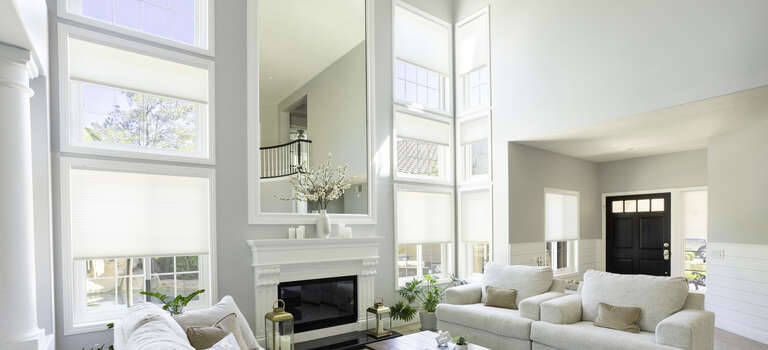
The road side of the house
Before you look at a single fabric, split the windows into two piles. One is every window that faces the road, the driveway or a neighbor. The other is every window that looks out at open land. Around Genesee that second pile can get long. In Kettle Moraine country, a house up on a rise can look across a whole valley from the kitchen.
The road-side pile is where this shade does the most good. On a lot of older farmhouses, the front room sits fairly close to a town road. Lower the top rail a foot or two and leave the rest of the shade down. You get daylight and a strip of sky, and a passing car sees fabric. Pick the fabric for how you use that room after dark. In a front room you only use by day, a light-filtering fabric glows a bit in the sun and keeps things from feeling shut in.
If you sit in the front room in the evening, choose room-darkening fabric from the start. Light-filtering fabric lights up like a lampshade once the lamps are on. Out in the country, a lit window stands out against a dark yard. A room-darkening top-down shade still works the same by day, with the top lowered a foot for daylight. Not sure? Hang a fabric sample in the window one night with a lamp behind it, and have someone stand at the end of the driveway.
The entry and the stairs work the same way. A window by the front door shows off the hall, the coats, the shoes and whoever's coming down in a robe. A home office on the road side is worth a look too. If your desk faces the window, covering the bottom keeps your screen private and still gives you light to work by. One small habit helps from the road: set all the road-side shades to about the same height during the day. A row of matching lines looks calm. A mix of heights looks messy, even if each room is set just right.
Leaves change all of this on a country lot. By late spring the trees fill in, and a road-side window can feel hidden all summer. Then the branches go bare in November, and that same window feels wide open again. So when you set the height of each road-side shade, picture the yard in late fall. Those rooms get cold about then too. Our post on insulated window shades for Eagle's long nights covers keeping them warm.
Old farmhouse windows and their trim
Plenty of older farmhouses out here have tall, narrow double-hung windows with wide wood casings. That trim is half the charm, and I'd try hard not to cover it. Mounted inside the frame, the shade leaves all that woodwork in view. On those windows I like a top-down bottom-up Roman shade in the Flat Fold style. It stacks up in plain, flat folds. In a simple fabric it suits an old house without any fuss. Lowered from the top, it covers the bottom half and leaves the top half open. On a front window that's often exactly the split you want.
Old frames can be tricky. Some are shallow. Others have so many coats of paint that the inside edges aren't straight anymore. If an inside mount won't sit cleanly, the shade can go on the trim or the wall above it. You cover a little woodwork, but you also hide the small gaps at the sides. We check every frame when we measure, and after the install we run both rails on each shade before we leave.
Old houses have odd windows too. You might have a half-round window in the gable or an angled one by the stairs. Cellular and woven wood shades can both be made to fit arched and angled windows. Most of those spots don't need the top-down feature at all. They just need something that fits. For a house full of original woodwork, our guide to window coverings for Waukesha's older McCall Street homes goes deeper on keeping trim in view.
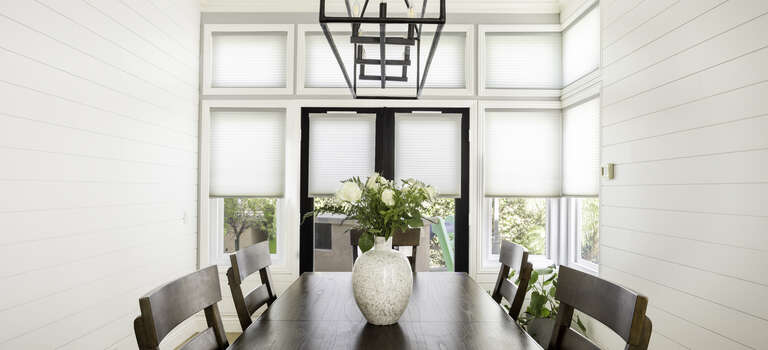
The field side and the bedrooms
Newer homes on a few acres often point the great room at the land. Some have a whole wall of glass. You're not hiding from anyone here. You want the shade out of the view's way. Most days I'd raise those shades all the way. At midday, when the glare comes off a bright sky, drop the top rail a little and leave the lower glass clear, so you can still watch the deer at the edge of the woods. Low evening sun is different. On a west-facing wall it comes in under the band and straight into your eyes, so for that last hour you lower the whole shade.
On the lower windows, a light-filtering top-down bottom-up cellular shade works well. It stacks up tight when it's raised, so you don't give up much glass. Keep the same fabric and mount on every window along that wall so it looks like a set. The windows above those are another matter. If you need a ladder to reach a window, nobody's going to adjust it. On that top row I'd use the same cellular fabric with a motor, and keep the windows you can reach cordless.
On the field side at night, you may not care at all. Plenty of people on acreage leave the back windows open after dark to see the stars. Just check what a side road or the neighbor's yard can see first.
An east bedroom that looks out over open fields gets every bit of the early light. In late May the sun's up before 5:30 around here. The sky starts to brighten half an hour before that. For that room I'd go with a top-down bottom-up cellular shade in a room-darkening fabric. Close it all the way at night. In the morning, drop the top rail a few inches. A strip of sky comes in, and nobody outside sees anything but fabric. Need it really dark? Add light guards or block-out channels to seal up the sides.
May is open-window season, too. Nights here still dip into the 40s, which is great sleeping weather. On a double-hung window, lower the top of the shade and open the top sash for air. The bottom of the window stays covered.
Kitchens, baths and the patio door
The kitchen sink window faces the driveway in a lot of houses. Right over the sink, I'd go with faux wood blinds instead of fabric. They hold up to moisture. A cellular shade is fine on a kitchen window that's away from the splash. You give up the top-down trick with a blind. But you can tilt the slats so anyone outside sees the ceiling instead of you. Bathrooms are the same call. I'd lean toward faux wood blinds. In a bath that stays dry, a top-down bottom-up cellular shade gives you light up top and privacy below.
The mudroom is where the boots, coats and dog leashes live, so cover the lower glass and nobody pulling into the driveway has to look at that pile.
The patio door is the exception. Top-down bottom-up rarely works there. You open that door over and over from spring to fall, so it needs a covering that moves sideways. Vertical blinds and sliding panel tracks both slide out of the way of the door. If the door shares a wall with top-down cellular shades, a vertical cellular shade on the door is the closest match, so that wall still looks like one set. If it's the door the dog uses all day, though, I'd pick vertical blinds. They wipe clean and stand up to traffic better than fabric.
If you'd like someone to walk the house with you, that's what our free in-home consultation is for. Ask us about top-down bottom-up shades in Waukesha farmhouses, and we'll start with the room where you feel watched.
Kevin Sill is CFO and co-owner of the family-owned Budget Blinds franchises serving the Waukesha area.