
Window Treatments in Waukesha Homes for Overnight Guests
Walk in your own front door one evening the way an overnight guest will. Start at the porch and follow them through the front room and the dining room, then up to the bed under the roof. In a story-and-a-half Craftsman around Waukesha, that walk tells you which window treatments need help before anyone arrives. It doesn't take a remodel, just the right covering in a few rooms.
Through the porch door
Guests meet the porch first. When family stays over it turns into the coat room, the spare fridge and maybe the kids' table. It's also a row of windows on the front of the house. Flip on the porch light after dark and the whole street can see who's out there.
For a picture of the type, the state's historic survey has a 1920s Craftsman on Maple Street in Palmyra with the same story-and-a-half shape and enclosed porch.
A porch doesn't need much. Simple roller or cellular shades do the job, and light-filtering fabric is fine for the day. If the porch gets used in the evening, go room-darkening on the windows that face the street. Keep one fabric and one color across each row of porch windows, so the porch looks tidy from the sidewalk.
An enclosed porch can run cold too, and cellular shades help a little with that cold glass.
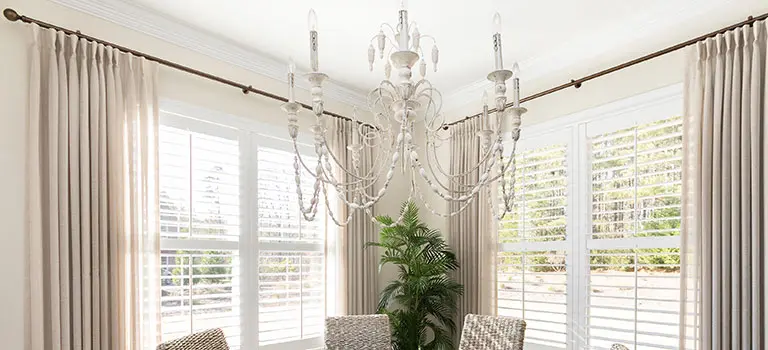
The front room once the lamps come on
On a winter visit it's dark in Waukesha by dinner. Most of your guests will walk in after dark and head straight for the front room. It's also the room people on the street can see best.
Front window privacy after dark takes something that closes all the way. A light-filtering shade alone won't. With the lamps on, people outside can still see someone moving behind it. Waukesha's Madison Street Historic District is full of front rooms like this, in Foursquare and Craftsman houses built between 1913 and 1923. In a Craftsman front room I like a Roman shade with a room-darkening lining. The flat folds suit the plain wood trim, and the room still feels soft and warm with it down. We set up a whole cold-day room around lined Roman shades in another post, and the same shade works here.
Rather keep a lighter fabric for daytime? Add a second layer for the evening. Side panels work well. They stay open all day and close when the first car pulls in.
Under the dining room chandelier
Sit at your own dining table one evening with the chandelier on. Look at the window. You'll probably see the fixture bright and doubled in the glass, and it shows up in photos too.
A lowered shade in a soft color fixes the reflection and blocks some chill for whoever sits closest. Drapes add more. A thermal lining helps hold warmth near a cold pane. Hang the rod a little above the window frame and let the panels run to the floor. In an older room with modest ceilings, that makes the whole room look taller.
You can compare the lining choices and header styles on our drapes page.
The kitchen door everyone uses
In a lot of families the back door gets more use than the front. On a big family day it swings open all day for dishes, coats and the dog. If yours has glass, that's a lot of motion for a shade.
A cellular shade mounted right on the door is a good fit, since it stacks up tight. Size it to clear the handle so it doesn't snag every time the door opens. A light-filtering fabric keeps the kitchen bright. If the door faces a neighbor's driveway, room-darkening fabric gives you more privacy after dark.
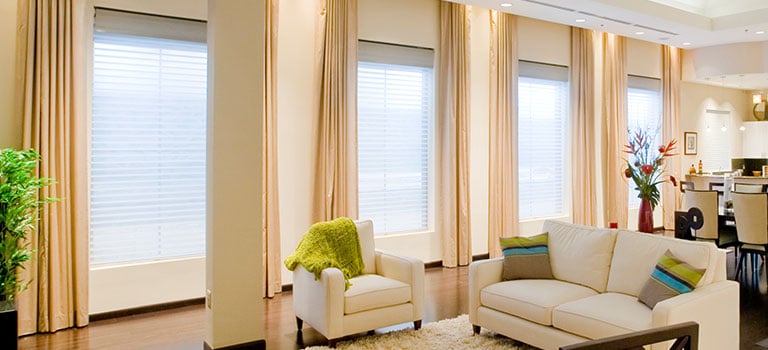
Window treatments for the guest room under the eaves
Now head up the stairs. A guest room under the roof usually has small windows, and some sit low in a knee wall. Some are tucked into a dormer with the ceiling sloping down on both sides. Rooms under a roof can run cold, too. Waukesha's East Broadway Historic District is mostly bungalows and Period Revival houses from about 1915 to 1939. Houses of that age around here often tuck a bedroom up under the roof like this.
Guest room blinds or shades up here have two jobs: keep out the streetlight and hold onto whatever warmth the room has. A room-darkening cellular shade covers both. For a guest who wants it truly dark, add side channels to close the thin gaps along each side of the shade.
Check the dormer frame before you pick a mount. A shallow frame may need the shade mounted on the wall above the window. That outside mount also laps past the edges and blocks more light. If that upstairs room still runs cold in winter, layering a drape over an insulated shade is the next step.
If the shade in that room has been up there for years, give it a gentle clean before anyone arrives. Our cleaning card for each type of shade tells you what's safe.
Which room comes first?
You don't have to do every room at once. Given only one room before guests come, I'd do the front room. It's where everyone ends up, and it's the room the street sees every evening. A guest room can get by for one visit with a spare blanket over the curtain rod. The front room can't hide like that. If that's the room on your mind, we'll come out and go over window treatments in Waukesha with you in it.
Kevin Sill is CFO and co-owner of the family-owned Budget Blinds franchises serving the Waukesha area.