
Do's and Don'ts for Woven Wood Shades in the Quad Cities
The woven wood shade I see go wrong most often is an unlined one in a front bedroom. It looks warm and natural all day. Then evening comes and the weave lets the room show through. Natural shades suit an old Rock Island house well. If you're looking at woven wood shades in the Quad Cities, line the ones you'll close at night and keep them away from water.
Can people see in through a woven shade after dark?
Yes, if there's no liner and the lights are on inside. An unlined woven shade behaves a lot like a sheer. By day it softens the sun and blurs the view in from the street. After dark your lamps shine out through the small gaps in the weave, and the room shows to anyone on the sidewalk.
Do add a liner on any shade you'll pull down for privacy at night. A liner is a thin fabric layer on the back of the shade. A privacy liner is the usual pick for a living room or a front bedroom. A blackout liner blocks the most light, so it suits a bedroom you want dark at 6 in the morning. A back window that only looks at your own yard can skip the liner and keep its speckled light.
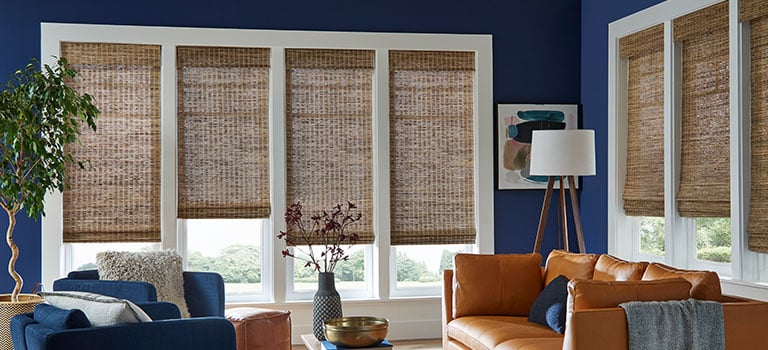
Do think about what the street sees
On an old front, the backs of your shades are part of what the street sees. Rock Island takes that view seriously. The city requires a Certificate of Appropriateness for changes to the outside of any Rock Island Landmark, and Highland Park Historic District homes are treated the same way (City of Rock Island). The city doesn't review shades. Your neighbors still see the liners every night.
Use one fabric and one liner across the front. Two liner colors side by side show up from the sidewalk at dusk. The rooms in back can differ when the light there is different. A bedroom on the alley side can take a blackout liner while the parlor in front keeps a privacy liner.
Do finish the edges on an old window
Edge banding is a strip of fabric bound along the sides of a woven shade. It gives the rough edge of the weave a neat border. On a house with painted trim, I like a band that matches the trim color. The shade then looks framed by the window instead of pinned inside it.
Old frames take a little more care at the edges. Most Highland Park homes went up between 1895 and 1928, per the city's district page. If an old frame is out of square, a woven shade inside it can show a thin gap that grows from top to bottom. We check every opening at the visit, so the shade fits the frame you have. Our home show measuring guide explains inside and outside mounts if you want to look ahead.
Do look at the operating choice while you're at it. Our woven shades come cordless, or you can go motorized. Top-down/bottom-up is an option too. On a front window right by the sidewalk, it lets you lower the top for daylight while the bottom stays covered. The north Bettendorf post on setting a top-down shade covers how far to lower it. Woven shades can also be made for arch-top and angled windows, which helps on an old house with one odd window in the stairwell. Landings get their own section in our window ideas by house layout.
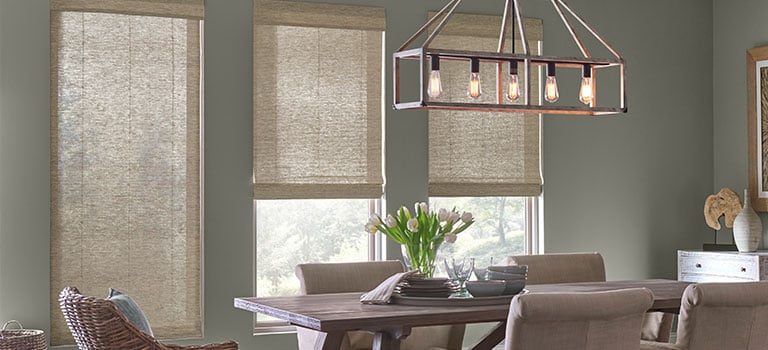
Woven wood shades: what they do well, and where they struggle
The big plus is the look. You can see the texture of a woven shade from the doorway, and flat fabric can't do that. It brings a bit of the outdoors into a room full of painted trim and plaster walls. They also filter daylight in a soft, even way that flatters old wood floors. You'll find the materials and styles on our woven wood shades page.
The minuses are worth knowing before you order. Natural fibers and steam don't get along, so leave the bathroom and the sink window to something you can wipe down.
Don't count on a woven shade to warm a cold window either. Even lined, it's a light layer. The city's design guidelines for landmarks and Highland Park ask owners to keep and repair the original windows. If yours are still the old sash, the glass by your favorite chair may run icy all winter. A cellular shade is the better pick for that one spot, and the woven shades can carry the rest of the room.
My own rule for an old Rock Island house
Line the front and match the edges to the trim. Leave the back windows natural where you can. Whoever you buy from, ask how the liner will look from the street before you pick a fabric. Call us about woven wood shades in the Quad Cities if you'd like a second opinion on that view.
Kevin Sill is CFO and co-owner of the family-owned Budget Blinds franchises serving the Quad Cities.