
Older Elm Grove Home? Plantation Shutters in Brookfield WI
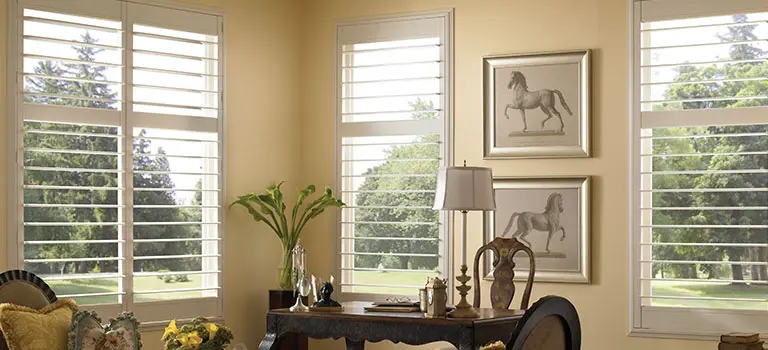
A lot of Elm Grove's older homes have tall, narrow windows and trim worth showing off. Plantation shutters suit them, because they look like part of the house instead of something hung in front of it. They sit inside the frame like built-in woodwork and fit tall, narrow windows well. You tilt the louvers to control light and privacy. Weighing shutters for an older house in Brookfield or Elm Grove? Start by looking hard at your trim. The shutter should work with it.
Why they suit older windows
Walk the oldest stretch of Watertown Plank Road and look at the windows. They're tall and narrow with real wood trim. Some have arched tops. One brick house there from 1860 has arched windows with hoods and half-round windows up in the gables. Shutters frame glass like that the way the old trim does. Plenty of newer homes in the village still have painted casings and double-hung windows. Nearly everything here fits them too.
Arched and odd tops aren't a problem. Shutters can be made for specialty shapes, including arches and circles. An arched shutter with louvers that fan out like a sunburst looks great on the right window. On a half-round high in a gable that never opens, some people leave the glass bare. That's easier to decide standing in the room.
Real wood, composite or one of the others
Shutters come in five materials. In an older home I usually steer people toward real wood or composite.
Real wood is the classic choice for the living room, dining room and den. It takes paint or stain, and it looks right next to old wood trim. Composite is the one for a bathroom or kitchen. Real wood can warp in a steamy room. Composite is made to hold up to humidity without warping or peeling.
Faux wood, vinyl and hybrid are the other three. Painted white, faux wood looks close to real wood from across the room. Vinyl and hybrid are other man-made choices, and they're easiest to judge with samples in your hand, which we bring to the visit.
Whichever you pick, match it to the trim. In an old house, the casing is often the best thing about the window. Snap a close-up photo of it or find a spare piece of trim in the basement. Compare finishes against that. White isn't just white, and a shutter that's a shade off will bother you every time you walk by.
Louvers, tilt rods and doors
Louvers come in a range of widths, from narrow to wide. The width changes both the look and the view. Wider louvers give a more open view when they're tilted flat, and there are fewer lines across the glass when you look out at the yard. On a big window that faces the yard, I'd lean that way. Narrower louvers look more traditional and suit a slim window, where a big louver can look out of scale.
The tilt rod is the bar down the front that angles the louvers. In an older house I'd keep the classic rod, because it looks like it belongs. In a newer room, a hidden rod looks cleaner. There are no cords on a shutter at all, which makes them an easy fit for a kid's room. A window that's hard to reach can be motorized.
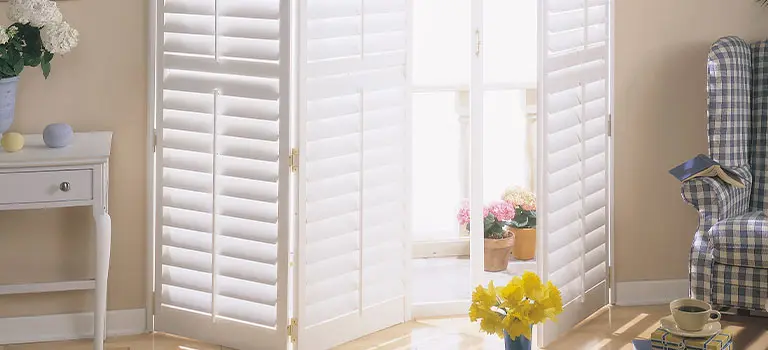
Shutters work on French doors and sliding glass doors too. A bi-fold track lets the panels hinge and fold out of the way. On a French door the panels move with the door, so check that the handle and the panels clear each other. On a slider the panels need room to fold to the side. We look at the space around every door when we measure. Doors are where seeing it in person saves the most guessing.
The downsides, and what to pair them with
Shutter panels swing into the room. A chair, a radiator or a deep sill near the window can get in the way. Check the space first. The frame also stays in view. Even with the louvers tilted open, the panels cover part of the glass. If you want a totally clear view, a shade that lifts away suits that window better.
Shutters won't make a bedroom fully dark, either. Light slips in where the louvers meet and around the edges of the panels. If you need a dark room, add blackout-lined drapery you can close over them at night. Or put a blackout shade on that window instead.
Old frames aren't square. Windows in older homes settle, which is why shutters are made to measure and why we measure every opening in person. And shutters are a fixed look. They aren't a seasonal swap like drapery panels, so pick a color you'll still like for a long time. The louvers need dusting too.
Are they still in style? I'd say so. In an older home they look like they came with the house, more like trim than decor, so they don't date the way a fabric trend can. What's changed is how people use them. White or soft white painted to match the trim is still the usual choice. A lot of people soften a formal room with drapery panels on each side. Our post on layering drapery in Brookfield and Elm Grove rooms shows how panels can frame a window.
You don't need shutters on every window, either. A lot of homes put them in the front rooms and use shades at the back. The front looks consistent from the street, and the back rooms stay more casual. Starting with one tired room? Our post on updating a dated Brookfield room compares shades, shutters and drapery side by side.
Six questions to see if plantation shutters fit
Run through these for one window at a time.
- Do you want the window to look like part of the house, instead of having fabric hung in front of it?
- Will the panels clear the furniture, radiator or sill when they swing open?
- Is the window tall and narrow, with trim you'd like to show off?
- Does the room need fine control over light, like a dining room or a home office?
- Are you happy with a look that stays put for a long time?
- Is it a dry room? If not, are you fine going with composite?
Mostly yeses, and shutters are a good fit for that window. A couple of nos, and a Roman shade or a cellular shade might suit it better. Plenty of homes end up with both.
When you'd like help deciding, book a free in-home visit and have that trim photo handy. Materials and options are on our plantation shutters page. Our home page has more about plantation shutters in Brookfield and Elm Grove. If you go ahead, our own crew installs the shutters and takes the old blinds away.
Kevin Sill is CFO and co-owner of the family-owned Budget Blinds franchises serving Brookfield and Elm Grove.