
Window Treatments for Large Windows in Brookfield
Once the leaves drop, a two-story wall of glass can throw sun clear across a great room by noon. That's usually when people start asking about window treatments for large windows in Brookfield. For big glass that has to work after dark, my first pick is a sheer shade. Put motors on anything you can't reach. If daytime glare is the only problem, a solar shade is simpler.
How do you cover huge windows in a two-story room?
Count the openings first. A tall great room wall is usually several windows stacked or set side by side. Each one gets its own shade.
On a wall you see all at once, the shades should look like they came as a set. Give every window there the same fabric, and mount them all the same way. A single odd shade on a big wall is the first thing anyone notices. A different wall can get a different fabric if the sun hits it differently.
Stacked windows bring a choice. You can cover the lower row and leave the transoms bare. That keeps the light up high and is the easiest to live with. Add shades to the top row only if the sun from up there hits a seat or a screen, or if the room needs to get dark.
Arches and half-rounds are normal work for us. If your big window is a bay, our post on custom blinds for bay and bow windows takes it panel by panel.
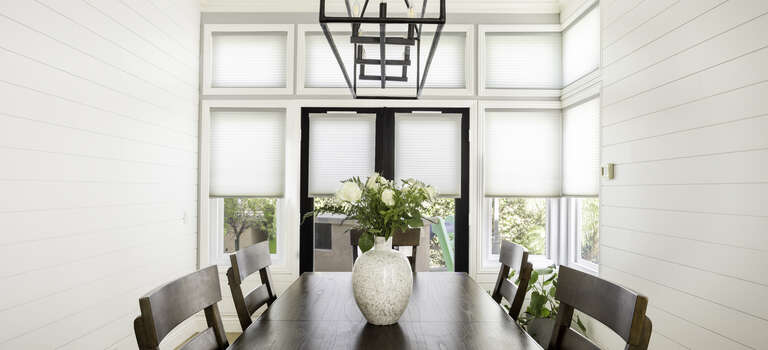
Why does the low winter sun reach so far?
Two things change at once. The leaves come down, and the sun sits at its lowest. At midday on the shortest days it climbs only about a quarter of the way up the sky. Light that cleared the room in summer then runs straight across the floor and up the far wall.
If your great room looks toward the Fox River woods at Mitchell Park, those trees stay bare until spring. Plan that wall for full winter sun.
Some yards lost their shade for good. The city's ash borer FAQ says the pest turned up all over Brookfield. The city has been removing public ash in poor condition. If an ash used to shade your great room, pick that wall's fabric for summer as well as winter.
Which way the wall faces tells you how open the weave can be. Facing south, a middle openness keeps the yard in view and cuts the glare. Facing west, a tighter weave works better because the late sun stays low and in your eyes.
How do you reach a shade fifteen feet up?
You don't, unless it has a motor. A shade on a high window that has to be raised by hand tends to stay wherever it was installed.
A motor fixes that. You run the high shades from a button or a schedule, and you can group every shade on one wall so they move together. Battery-powered motors go up without any new wiring, which suits a finished great room.
What about privacy on tall glass after dark?
Big windows catch a lot of people off guard at night. A solar shade is see-through once the lights are on, and bare glass is worse.
Side glass is easy to forget. It feels private by day, but a lit side window faces the house next door at night. Give it the same night layer as the back wall.
Sheer shades handle both shifts. Two sheer layers hold soft fabric vanes between them. Open, the room keeps its light and you still see the yard. Close the vanes at night and the window is covered. They're light enough for wide windows and roll up into a headrail that hides itself.
If you prefer the solar look by day, plan a second layer for night. On a tall wall that usually means motorized drapes on a track, or a room-darkening shade behind the solar one.
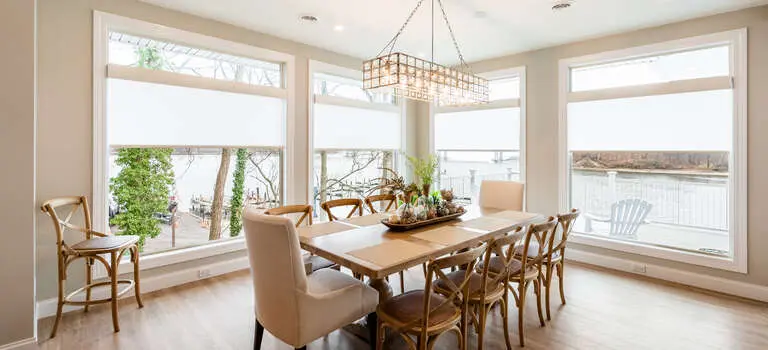
What makes a big window look expensive?
It's less about the product than how it fits. A cheap look on a big window usually comes from a few things you can spot from the doorway. One shade sits lower than the rest. The headrails show. Thin strips of light run down the sides. Fix those three things and the wall looks finished.
Drapes help on a tall wall when they go nearly floor to ceiling. Short panels make a two-story room feel shorter. Long ones on a ceiling track make it feel grand. Our post on drapery layered over shades shows three ways to hang them.
A patio door in that wall is covered in our sliding door post for snowy yards, and a tall dining room gets its own dining room ideas.
A two-story wall is also a lot of cold glass. Winter nights here average well below freezing. A room-darkening cellular layer behind the daytime shade can help the room feel warmer at night.
Where should a big-window project start?
Start with the wall you look at most at night and the one where sun lands on a seat or screen. On many two-story houses that's the same wall. Settle the fabric and the motors there first. Then match the foyer and the rest of the room to it, one wall at a time. Get that first wall right and the rest of the house is just matching. Our visits about window treatments for large windows in Brookfield usually begin at that wall for the same reason.
Kevin Sill is CFO and co-owner of the family-owned Budget Blinds franchises serving Brookfield and Elm Grove.