
Shutters Near Rochester MN for Older Stewartville Homes
Can shutters work in an older house where no two windows measure quite the same? In an older Stewartville home they usually can, because each panel is built to fit its own opening. Tall front windows, a bay and a dining room with old wood trim are where I'd put shutters around Rochester first. The kitchen gets composite, and a bedroom where someone sleeps late will want drapes over the shutters too.
The front window that faces the street is its own small puzzle, and café shutters solve it nicely.
What makes an older Stewartville house different at the window?
Stewartville began as a small prairie village back in the 1800s. The city's own page for new residents describes established neighborhoods with stately homes next to the newer subdivisions. Houses like that tend to have the tall front windows and wide trim that shutters suit.
If your house is older, the frames may have shifted a little over the years. Then two windows that look the same can measure differently. The trim may be wider and worth showing off, and a radiator or a heat register may sit right under the glass. Olmsted County handles building permits for Stewartville, and its window replacement form asks for the distance from the sill to the floor. That number matters for shutters too. A low sill over a radiator decides how far a lower panel can swing and where a café shutter should stop. None of that rules out shutters. It just means every window gets measured on its own. You also plan the swing of each panel around whatever sits below the sill.
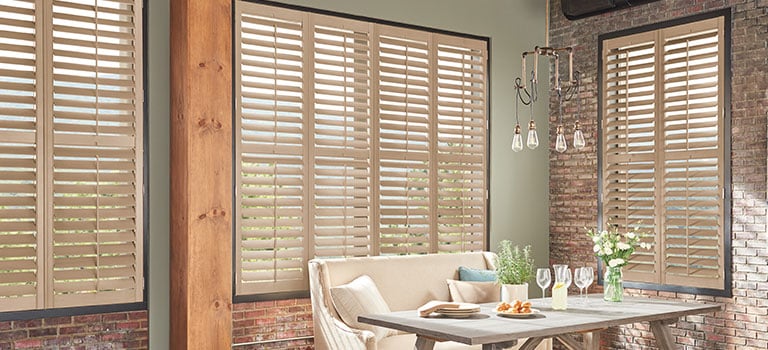
Shutters suit these rooms because they're built to fit the opening. Set inside the frame, they leave the trim in view and look like they've always been there. They also have no cords, which matters in a house full of kids or pets.
Which shutter goes on which window?
Most older houses have a handful of window types, and no two of them want quite the same shutter.
| Window | Pick | Why |
|---|---|---|
| Tall front window | Full-height shutters with wider louvers | Fewer louvers in the view when open |
| Bay window | A panel set on each window of the bay | Each angle tilts and opens on its own |
| Dining room with stained trim | Stained real wood shutters | The finish can tie in with the old wood |
| Kitchen by the sink | Composite shutters | Won't warp, peel or crack in damp air |
| Front window on the street | Café shutters on the lower half | Privacy below, daylight above |
| Bedroom that must be dark | Shutters plus room-darkening drapes | Shutters alone leak light at the edges |
Louver size matters in an old house. A very wide louver can look heavy on a tall narrow window, and a narrow one looks busy on a broad one. We bring a range of louver sizes so you can hold them up to the actual window. Materials and louver options are also on our plantation shutters page.
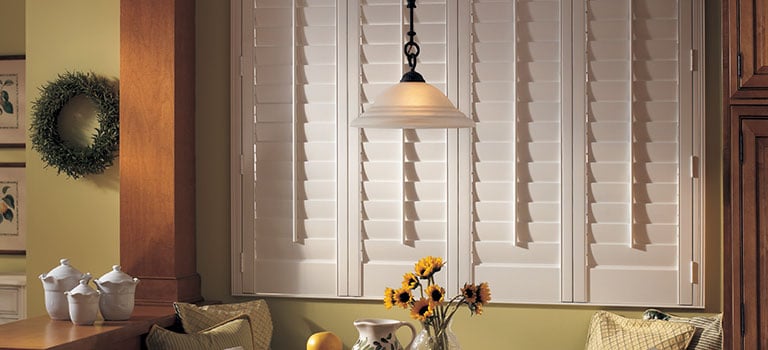
Color is usually the easy part. Painted trim gets a painted shutter. Stained trim gets a stained wood shutter, the classic pick. Hold the sample against the old wood, since old stain is rarely the color it looks from across the room.
What about the front window on the street?
The front window is the one the street sees. In winter it's dark by dinner. The lamps are on before most people get home, and the street can see right in.
Café shutters handle that well. They cover only the lower half. Someone on the sidewalk sees light up top and can't see the people on the couch. The top stays open for daylight. They come in wood and faux wood, or vinyl and composite. And since they're mounted for good, they do that job all year.
If you'd rather cover the whole window, full shutters still work. Close the louvers after dark. Open them again in the morning. The room then stays private all evening while the family is gathered in it.
What should you know before you commit?
Shutters aren't the warmest thing you can put on a window, and winter cold finds every gap around an old sash. If an old window feels drafty, fix the weatherstripping first. Then think about the room. For a cold bedroom I'd lean toward a cellular shade, since it does more for cold glass. The post on insulated shades for cold Rochester rooms covers that side.
Old houses also get frost. Before you decide how to set the louvers on a frosty window, read the frost myths and facts post. Any room that faces the street or a neighbor still keeps its louvers closed after dark for privacy.
The panels also swing into the room, so check what's near the window. Each louver catches dust, and a quick pass with a soft cloth keeps them clean. Shutters also won't give you a fully dark bedroom without help, which is why the table pairs them with drapes there. For someone who sleeps by day, the blackout shades post for Rochester day sleepers goes further.
Where to start with shutters
Pick one window to start, and I'd pick the front window that faces the street. Café shutters there keep the couch private all evening while the top of the window stays open. Ask us out to that window first, and we'll plan shutters in Rochester or Stewartville from there.
Kevin Sill is CFO and co-owner of the family-owned Budget Blinds franchises serving Rochester and southeast Minnesota.